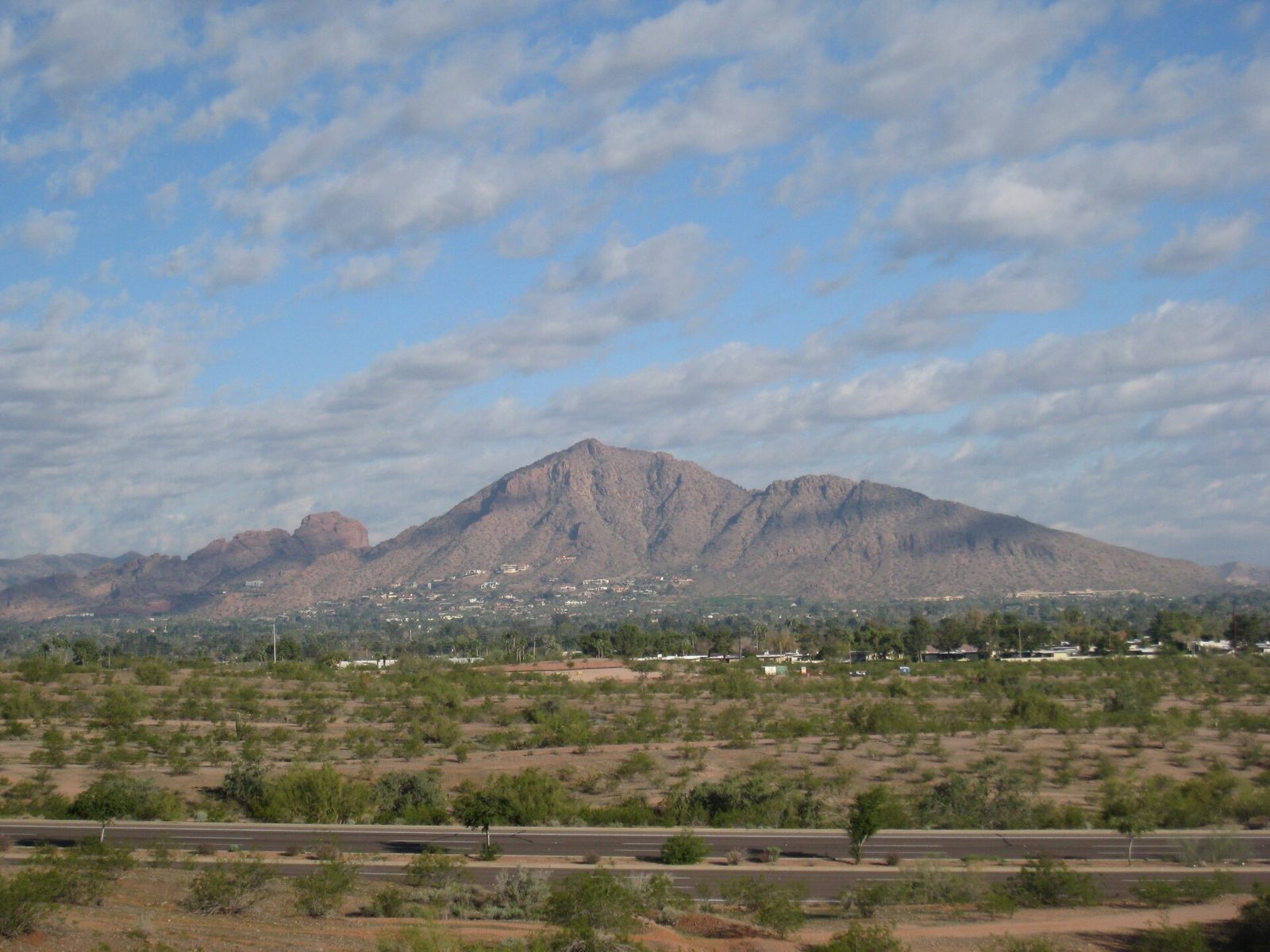
Phoenix is not one place, and it does not have one climate. The Musical Instrument Museum is a half-hour drive north of downtown, Taliesin West is 45 minutes northeast in Scottsdale, and the Salt River’s wild horses are 50 minutes east, past Mesa. The summit trail that makes a pleasant sunrise climb in February is off-limits from 8 a.m. to 5 p.m. on a summer day when the National Weather Service issues an Extreme Heat Warning, and in 2024 that happened on 45 days. Any useful list of things to do in Phoenix has to start with the map and the thermometer, so this one does.
Short answer: On a first trip, start with the Desert Botanical Garden, the Heard Museum, the Musical Instrument Museum and one mountain. From October to April, that mountain can be a sunrise climb up Piestewa Peak or Camelback, and in the same months you can drive up South Mountain to Dobbins Lookout for sunset. With a car and an early start, add Frank Lloyd Wright’s Taliesin West or the Salt River’s wild horses. From May to September, flip the day: outside at first light, indoors by mid-morning.
Prices, hours, trail rules and closures in this guide were last checked on September 23, 2026. Drive times are off-peak estimates from downtown Phoenix; allow a third longer or more at rush hour.
Things to do in Phoenix at a glance
These are the Valley’s best attractions for a first visit, with what they cost and when to go. The notes further down explain each pick. Every price is the operator’s own figure, checked in September 2026.
| Attraction | Area and drive from downtown | Cost (checked Sept 2026) | Best time |
|---|---|---|---|
| Desert Botanical Garden | Papago Park, east Phoenix; 20 min | From $32.95 adults (Oct-Dec 2026); priced by date | Opening hour, October to April |
| Heard Museum | Central Avenue, midtown Phoenix; 5 min or light rail | $25 adults at the door, $22.50 online | Any day; free First Friday evenings |
| Musical Instrument Museum | Far north Phoenix, off Loop 101; 30 min | $20 adults, $15 teens, $10 ages 4-12 | Any season; allow 3 hours or more |
| Camelback Mountain | Arcadia, east Phoenix; 20 min | Free | Sunrise, November to March |
| Piestewa Peak Summit Trail | Phoenix Mountains Preserve; 20 min | Free | Sunrise, October to April |
| Dobbins Lookout, South Mountain | South Phoenix; 35 min | Free | Sunset, October to March; gates close at 7 p.m. |
| Hole-in-the-Rock | Papago Park; 20 min | Free | The hour before sunset |
| Taliesin West | North Scottsdale; 45 min | $44 adults, self-guided audio tour | Mornings, November to April; book ahead |
| Phoenix Art Museum | Central Avenue, midtown Phoenix; 5 min | $23 adults; pay what you wish Wednesdays 3-8 p.m. | Wednesday or First Friday evening |
| S’edav Va’aki Museum (formerly Pueblo Grande) | East Phoenix, by Sky Harbor; 15 min | $13 adults | Cool-season mornings; closed Tue-Wed |
| Roosevelt Row and First Friday | Downtown Phoenix; 5 min | Free | First Friday of the month, after dark |
| Salt River wild horses | Tonto National Forest, northeast of Mesa; 50 min | $8 Tonto Pass per car ($12 at the on-site machine) | Early morning or late afternoon |
| Hot air balloon flight | Desert north and west of the city; check-in varies | $239-$275 per adult before taxes and fees | Sunrise, year-round; kindest October to April |
| Suns, Mercury or Diamondbacks game | Downtown Phoenix, by light rail | Varies by opponent and date | In season; Chase Field is air-conditioned |
How should you choose what to do in Phoenix?
Four questions sort the Valley faster than any ranked list. Answer them in this order.
What month are you coming?
Temperature decides more here than almost anywhere else in the country. Phoenix’s normal high is 67.6°F in January and 106.5°F in July, according to the 1991-2020 climate normals for Sky Harbor. From late October to April you can be outdoors all day. May and late September give you the mornings. From June through August, outdoor plans should end by about 9 a.m., and on extreme-heat days the city makes its busiest summit trails off-limits outright. Plan the trip around the temperature, never the other way round.
Which side of the Valley are you sleeping on?
The things visitors come for are scattered across a metro area of about five million people. The big museums line Central Avenue in midtown Phoenix. The garden and zoo sit in Papago Park on the Tempe line. Taliesin West is in north Scottsdale, the Musical Instrument Museum is in far north Phoenix, and the horses are out past Mesa. Group each day by area. Crossing the metro at rush hour can cost you an hour you would rather spend somewhere else.
How much do you want to spend?
The free tier here is unusually good. The mountain preserves cost nothing, and neither do the sunset views or the First Friday art walk. Two of the best museums are free or pay what you wish on set evenings. The expensive items are few and predictable: a balloon flight, a Taliesin West tour, a resort pool, a game. Pick one or two and let the rest of the trip run cheap.
What time of day is it?
The desert rewards the edges of the day. Hike at first light and do museums through the middle of it. Be at a viewpoint for the last hour before sunset, then spend the evening on a patio, at First Friday or at a game. That rhythm is pleasant in January. In July it is the only way the day works.
The best Phoenix attractions, one by one
Each entry says where it is, what it costs, when to go and how long to allow. Prices are for adults unless noted and were checked in September 2026.
Desert Botanical Garden
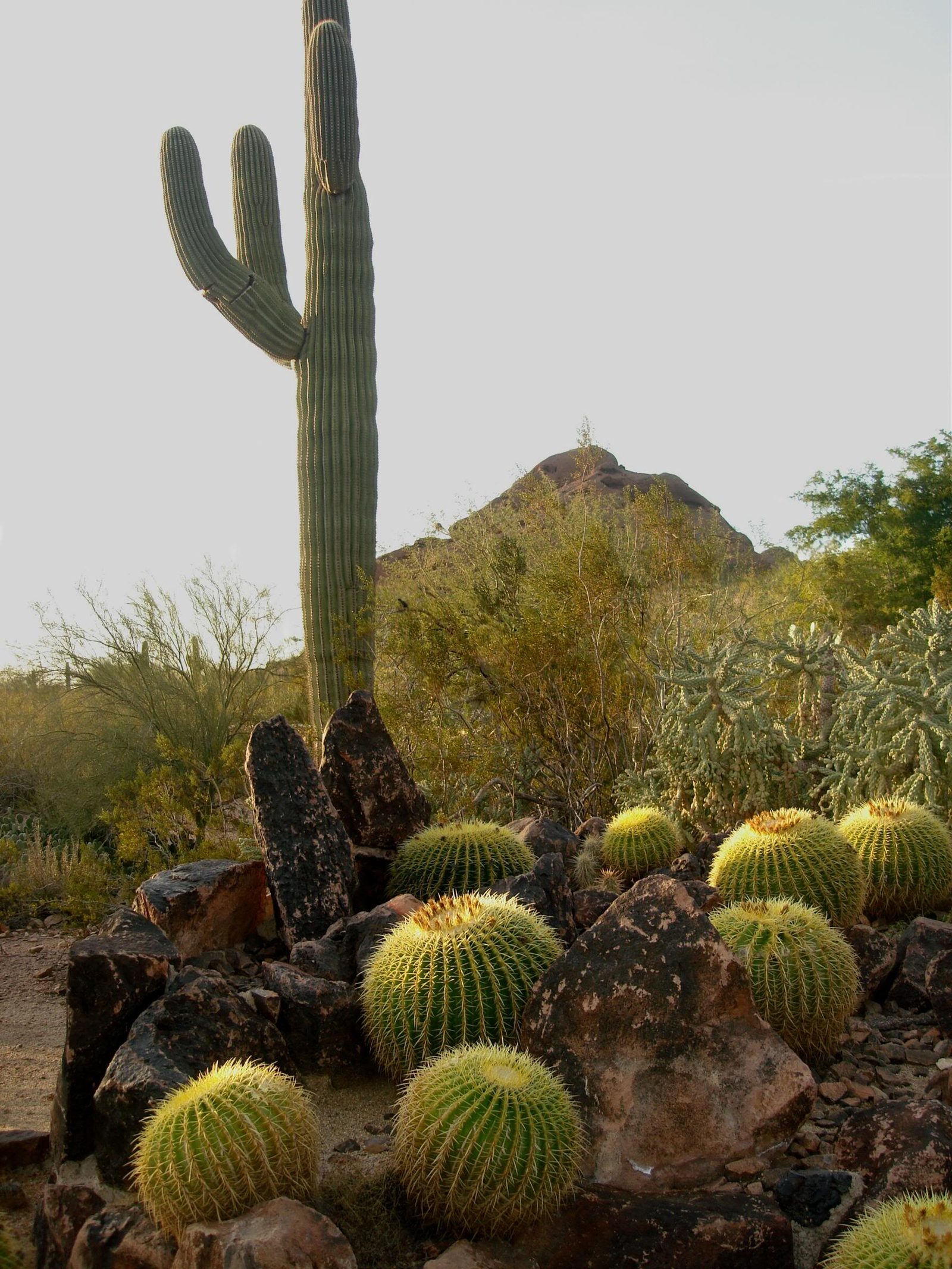
Papago Park, east Phoenix. About 20 minutes from downtown. If you do one thing in Phoenix, make it this. The garden’s loop trails are a slow, labeled introduction to the Sonoran Desert: towering saguaros and organ pipe cactus, agaves, a wildflower loop that peaks in March and April, and exhibits on how people have lived in this desert for centuries. It works as an orientation course, too. Everything you drive past for the rest of the trip will make more sense afterward.
Tickets are priced by date. For October through December 2026, adult admission runs from $32.95 and children’s from $14.95, and online tickets are usually cheaper than paying at the gate (checked September 2026). Community Day, on the second Tuesday of each month, is pay what you can; the next two are October 13 and November 10, 2026. The garden opens daily at 8 a.m. in the cool season. Through September 30 it runs a summer schedule, 6 a.m. to 10 p.m., with the trails closed from 1 to 5 p.m. for the heat, which tells you exactly when to go: at opening or in the evening. Las Noches de las Luminarias, the candlelit holiday nights, run on select dates from November 27 to December 30, 2026, and need their own ticket. The garden’s visit page has the current date-by-date prices. Allow two to three hours. The Phoenix Zoo and Hole-in-the-Rock are a few minutes away, so this is the anchor of an east-Phoenix day.
Heard Museum
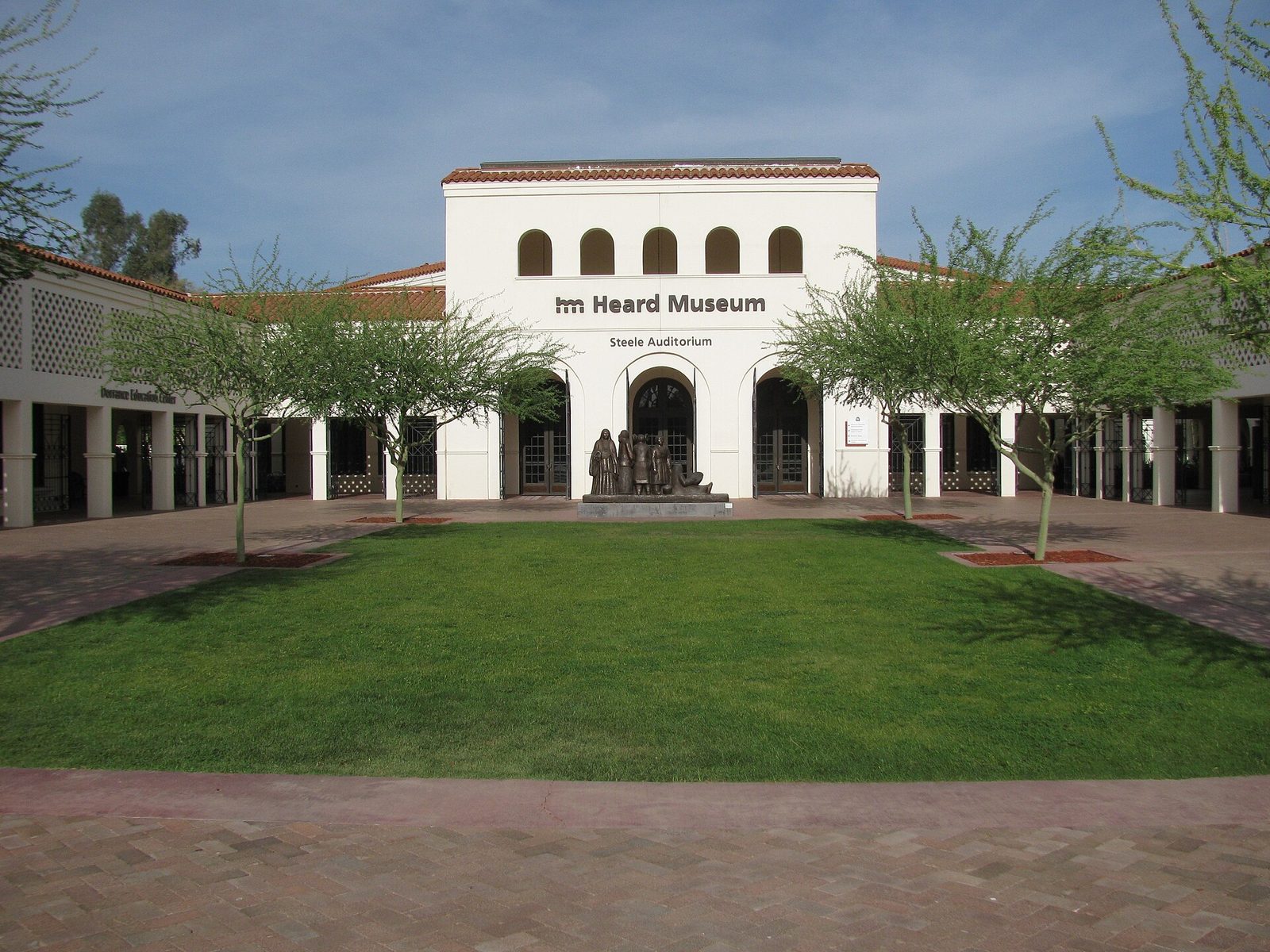
Central Avenue, midtown Phoenix. Five minutes from downtown, or a short light-rail ride. The Heard has been collecting and showing the art of the Southwest’s Native peoples since 1929, and it is the one Phoenix attraction you cannot replicate anywhere else. Its galleries hold pottery, basketry, jewelry, textiles and a large collection of katsina dolls, alongside contemporary work by Native artists. Hours are 10 a.m. to 4 p.m., daily from September through May; from June through August it closes on Mondays. Adult admission was $25 at the door or $22.50 online when checked in September 2026. Those are the museum’s published prices, but its ticket system prices by date, so confirm when you book. Entry is free on First Friday evenings from 4 to 8 p.m.; the next is October 2, 2026. Give it two to three hours, and leave time for the shop, which sells work by Native artists.
Two annual events are worth planning around. The World Championship Hoop Dance Contest takes place on February 6-7, 2027, and the Heard Museum Guild Indian Fair & Market, now in its 69th year, on March 6-7, 2027.
Musical Instrument Museum
Far north Phoenix, off Loop 101 near Tatum Boulevard. About 30 minutes from downtown. MIM is the attraction people underestimate. Its galleries are arranged by world region, with instruments from almost every country on earth. The headset included with admission switches on the sound as you walk up to each display, where screens show the instruments being played, so you spend the visit hearing music you have probably never heard before. There is also a hands-on gallery where you can play instruments yourself. Admission is $20 for adults, $15 for teens 13 to 19, $10 for children 4 to 12 and free for 3 and under (checked September 2026). Special exhibitions cost extra, and parking is free. It opens daily from 9 a.m. to 5 p.m.
Allow at least three hours. Plenty of people need two visits, and guest services sells two-day passes. This is the best air-conditioned half-day in the Valley, which makes it the obvious July plan, and it sits close enough to north Scottsdale to pair with Taliesin West on a cool morning.
Camelback Mountain
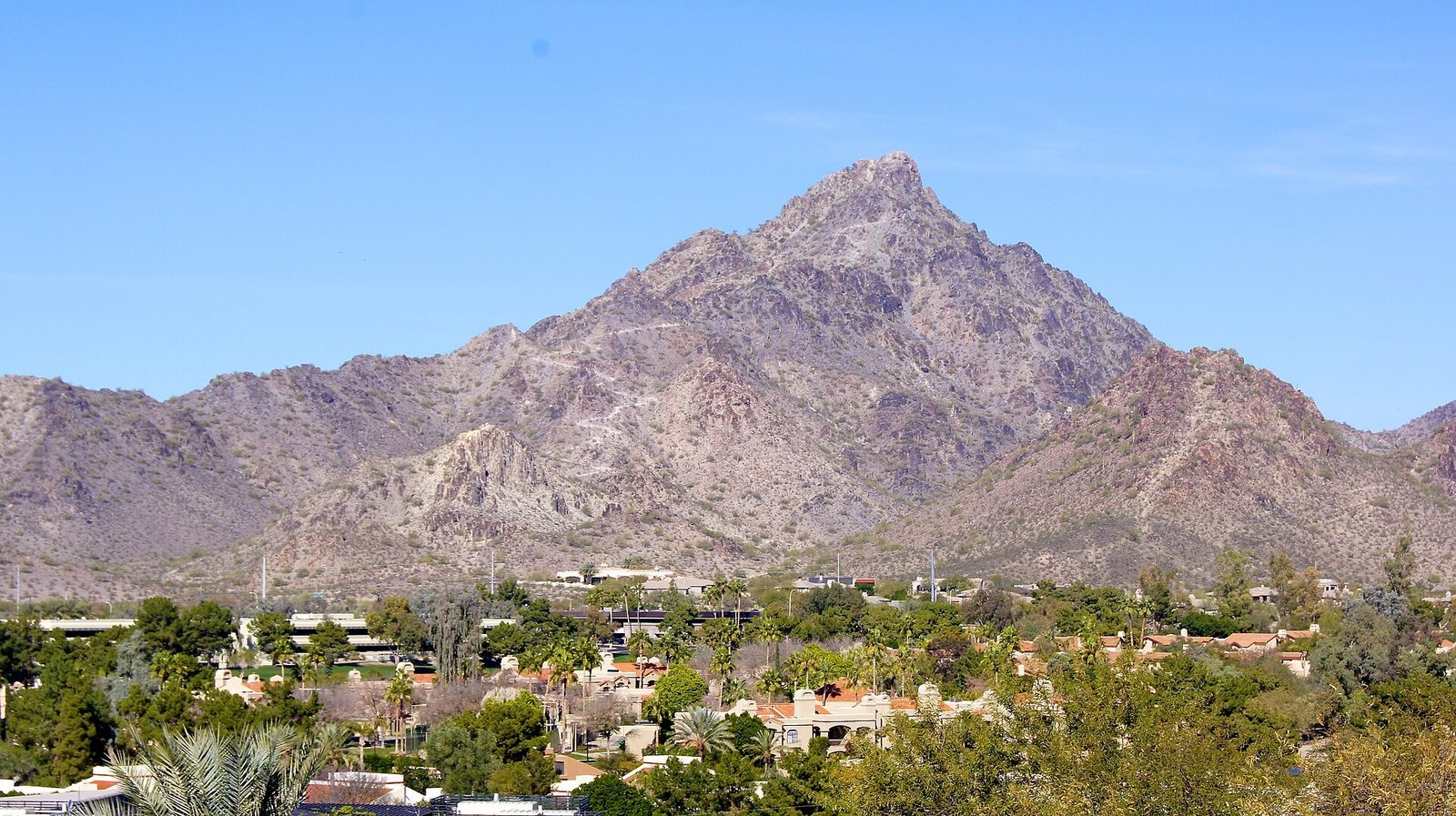
Arcadia, on the Phoenix-Paradise Valley line. About 20 minutes from downtown. Camelback is the Valley’s signature climb and its most misjudged. Both summit routes are short and brutal. The city lists Echo Canyon at 1.14 miles each way with 1,400 feet of elevation change, and Cholla at 1.5 miles with 1,420 feet, and rates both “extremely difficult.” Expect loose rock, handrails on the steepest pitches and almost no shade on the way to the 2,704-foot summit. The trails are open from sunrise to sunset. On days when the National Weather Service issues an Extreme Heat Warning, both are off-limits from 8 a.m. to 5 p.m. under the city’s trail heat restrictions, and dogs are banned from Camelback’s trails all year.
Parking is the other constraint. In winter and spring, the city says the Echo Canyon lot is typically full from late morning to early afternoon on weekdays and all day on weekends. When it fills, the gate closes, and police ticket drivers who idle on McDonald Drive or Tatum Boulevard waiting for a space. The Cholla trailhead has only marked parallel parking along Invergordon Road. Go at sunrise between November and March, carry more water than seems sensible, and turn back if you are unsure. If you want the view without the scramble, Piestewa Peak or Dobbins Lookout gets you most of it.
Piestewa Peak
Phoenix Mountains Preserve, north-central Phoenix. About 20 minutes from downtown. The Summit Trail on Piestewa Peak is Camelback’s slightly friendlier sibling. The city lists it at 1.2 miles each way with 1,200 feet of elevation change, also rated extremely difficult, but it is a steady, well-worn climb rather than a scramble. From the top you look across downtown, Camelback and most of the north Valley. The peak was renamed in 2003 for Lori Piestewa, a Hopi soldier and the first Native American woman in the U.S. military known to have died in combat, so older maps and guides may still use the previous name.
The same heat rule applies: on Extreme Heat Warning days, the Summit Trail and its connecting trails are off-limits from 8 a.m. to 5 p.m. Dogs are never allowed on the Summit Trail, and on any city trail they are banned when it is over 100°F. The park entrance opens at 5 a.m., and from June through September the trailhead lot stays open until 9 p.m. for evening hikers. The rest of the preserve has gentler trails if you want the desert without the climb. At sunrise in January, this is one of the best free hours in Phoenix.
South Mountain and Dobbins Lookout
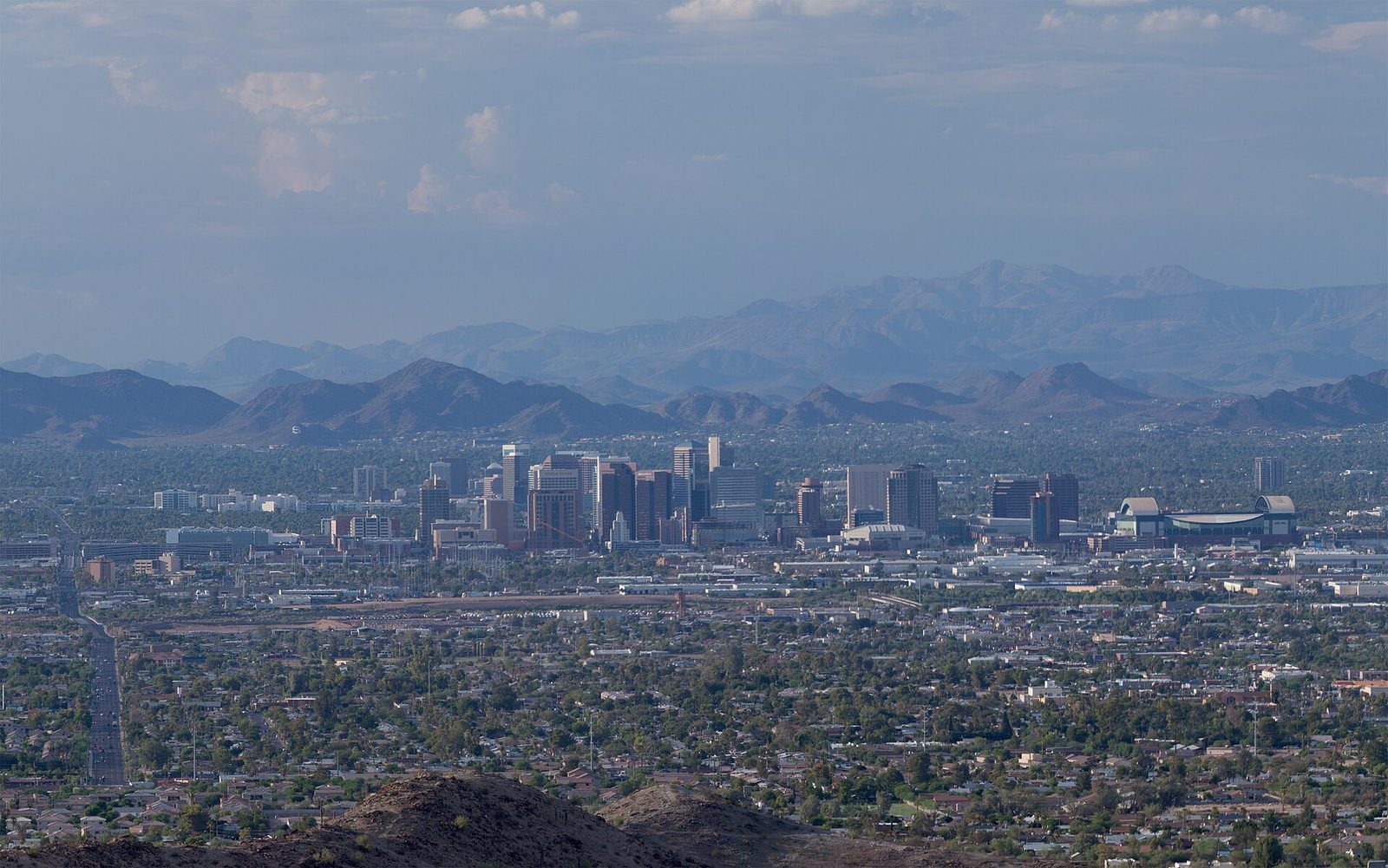
South Phoenix. About 35 minutes from downtown to the lookout. South Mountain Park and Preserve covers more than 16,000 acres with more than 100 miles of trails, which makes it one of the largest city-run parks in the country. You don’t have to hike it. Summit Road climbs to Dobbins Lookout at 2,330 feet, the highest point in the park open to the public, where a stone lookout shelter looks north across the whole Valley to downtown and the mountains beyond.
The park’s entrance and parking hours are 5 a.m. to 7 p.m. That makes a sunset drive practical from October through March, when the sun goes down well before 7, and impossible in midsummer, when it sets closer to 7:40. Check the calendar, too. On “Silent Sundays” the city closes Summit Road to cars from 5 to 10 a.m. at the one-mile marker, and on the fourth Sunday of each month it stays closed to cars all day. Three trails here, Holbert, Mormon and Hau’pal Loop, plus the National Trail’s access from Pima Canyon, fall under the heat restrictions. That is fewer than seven of the park’s 100-plus miles.
Hole-in-the-Rock and Papago Park
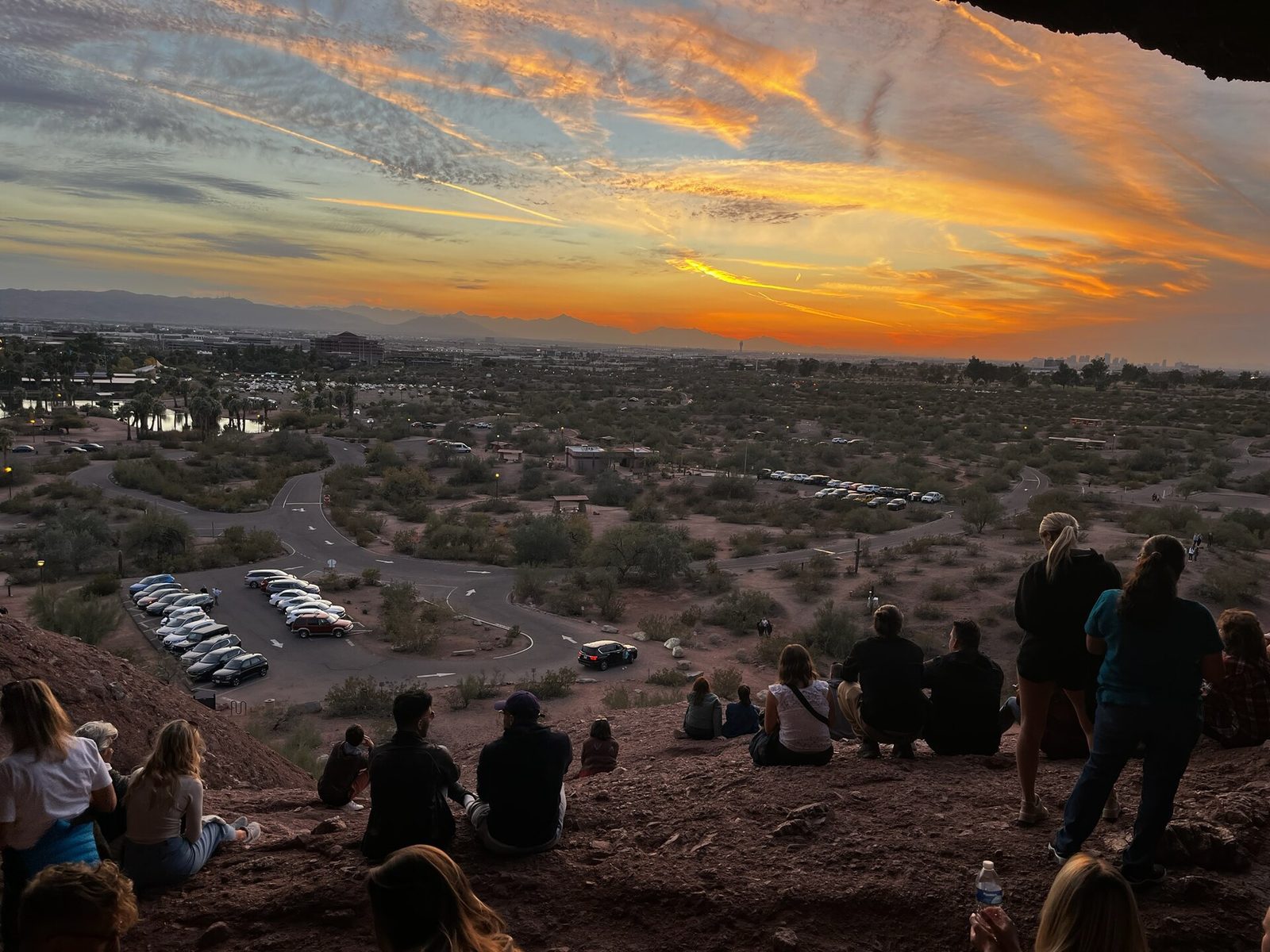
East Phoenix, on the Tempe line. About 20 minutes from downtown. Papago Park’s red sandstone buttes hold three of the Valley’s easiest wins. Hole-in-the-Rock is a 0.2-mile path, rated easy by the city, up to a natural opening in a butte that frames the view west over the park and the city. The climb takes a few minutes and is at its best in the last hour before sunset. The trailhead lot by the Papago Park Visitor Center, 625 N. Galvin Parkway, is open from 5 a.m. to 7 p.m., so a true sunset visit works from about mid-September to mid-April.
The Desert Botanical Garden and the Phoenix Zoo sit next door. The zoo charged $44.95 for adults and $32.95 for ages 3 to 13 when checked in September 2026, and keeps short hours in summer (7 a.m. to 1 p.m. from June through August) because of the heat. It suits families better than adults on a short trip.
Taliesin West
North Scottsdale, below the McDowell Mountains. About 45 minutes from downtown Phoenix. Frank Lloyd Wright started building his winter home and studio here in 1937, largely from desert stone and sand, and it is now part of a UNESCO World Heritage listing of his work. Going inside means taking a tour. The standard option is the self-guided audio tour, which takes 60 to 75 minutes and cost $44 for adults and $22 for ages 6 to 17 from October to May, dropping to $39 and $19 in summer (checked September 2026). The Behind-the-Scenes Tour ($110, about two to two and a half hours) runs at 10 a.m. on set weekdays from November 3, 2026, to April 30, 2027.
Taliesin West is open Wednesday to Monday in October 2026 and daily from November through April. The foundation calls reservations “strongly recommended,” and in high season the best time slots go first, so book through the foundation’s tour page rather than turning up. Guided tours are not intended for children under 6. If you care about architecture, this is the building in Arizona not to miss. If you don’t, the price buys a pleasant hour and not much more.
Phoenix Art Museum
Central Avenue, midtown Phoenix, a short walk from the Heard. The museum bills itself as the largest art museum in the Southwest, and its collections cover American and Western art, Latin American and Asian art, contemporary work and a strong fashion-design collection. Adult admission is $23, seniors pay $20, students $18 and ages 6 to 17 $13 (checked September 2026). It is closed Monday and Tuesday and stays open until 8 p.m. on Wednesdays and Fridays.
Those late nights are the ones to use. Wednesdays from 3 to 8 p.m. are pay what you wish, and First Fridays from 5 to 8 p.m. are free. One caveat for fall 2026: the museum’s Ballinger Wing is temporarily closed for infrastructure work, so check what is on view if you are going for something specific. Allow two hours, and pair it with the Heard on the same day.
S’edav Va’aki Museum
East Washington Street, beside Sky Harbor. About 15 minutes from downtown. Older guides call it Pueblo Grande Museum; the city now uses the O’odham name, S’edav Va’aki. It preserves part of a Hohokam village and its platform mound, with a short outdoor trail past the mound, a ballcourt and reconstructed homes. It is the best place in town to understand why Phoenix is here at all. The Hohokam dug hundreds of miles of irrigation canals across this valley, and the city that grew up along their traces took its name from a bird reborn from ashes.
Admission is $13 for adults, $10 for seniors and $6 for students and ages 6 to 17 (checked September 2026). From September to June it opens Monday, Thursday, Friday and Saturday from 9 a.m. to 4 p.m., with Thursdays running to 8 p.m., and Sunday from noon to 4. It is closed Tuesday and Wednesday, and in July and August it closes at 2 p.m. Allow 90 minutes, and walk the outdoor trail first, before the day warms up.
Roosevelt Row and First Friday
Downtown Phoenix, along Roosevelt Street just north of the high-rises. About 5 minutes from downtown. Roosevelt Row is the city’s arts district: murals, small galleries, bars and some of the street life the rest of Phoenix lacks. Its big night is First Friday, the monthly art walk that the nonprofit Artlink has run since 1994, when galleries and studios open free to the public. The same evening, the Phoenix Art Museum (5 to 8 p.m.) and the Heard (4 to 8 p.m.) are free, so one First Friday can stack three things for nothing. Official art-walk hours are not published and venues set their own. Most of the energy arrives after dark, which in summer is also when walking around becomes bearable.
The Salt River’s wild horses
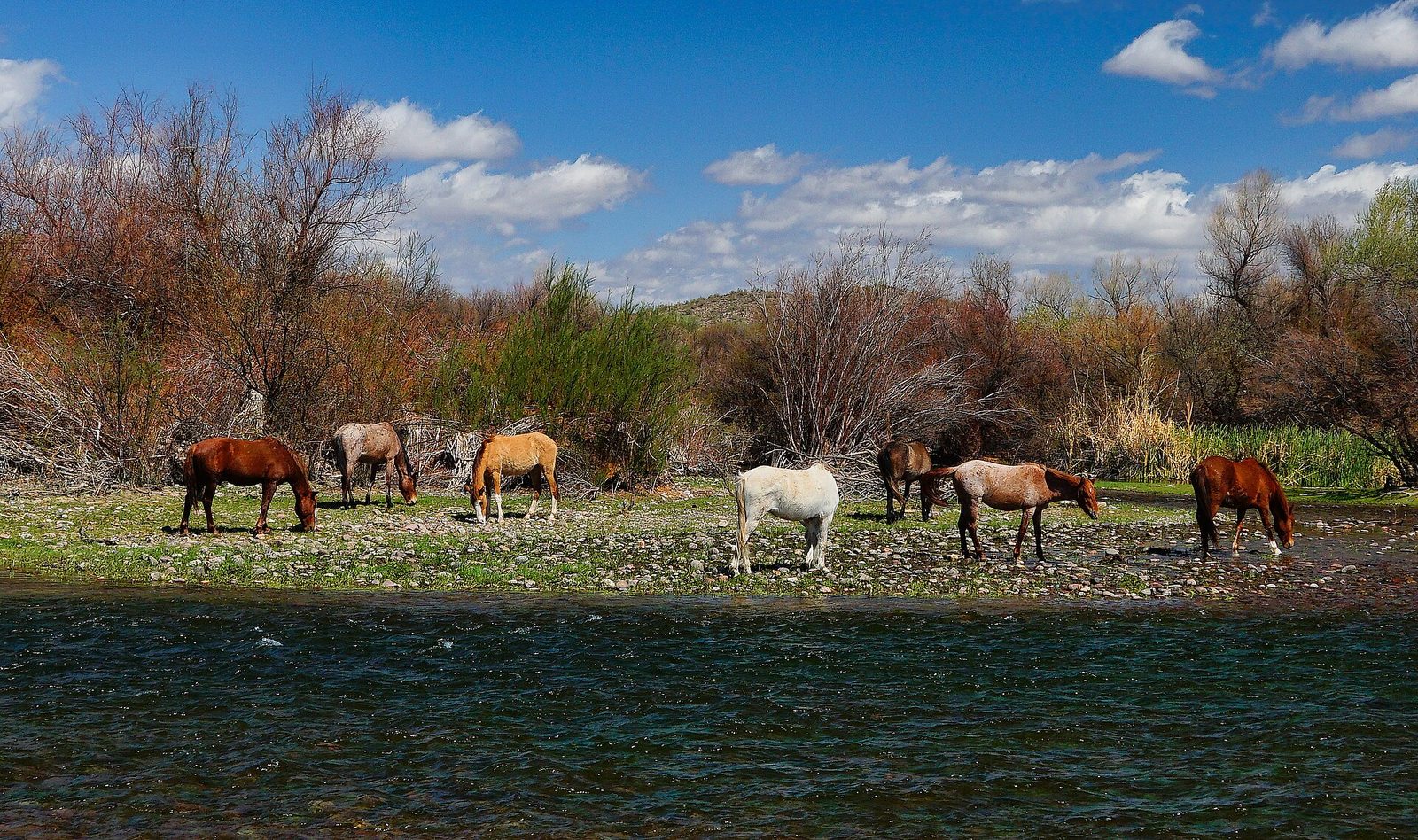
Lower Salt River, Tonto National Forest, northeast of Mesa. About 50 minutes from downtown. Bands of wild horses live along the Lower Salt River, and watching them wade into the water in the early light is one of the most memorable things you can do in the Valley for the price of a parking pass. The recreation sites along Bush Highway, including Phon D. Sutton, Granite Reef, Water Users and Raccoon Bluff (formerly Coon Bluff), are the usual places to look. Your best odds are within two or three hours of sunrise or sunset.
Parking at these forest recreation sites requires a Tonto Pass: $8 per vehicle per day from forest offices and retailers around the Valley, or $12 at the on-site machines (checked September 2026; the Forest Service pass page lists vendors). The Salt River Wild Horse Management Group asks visitors to stay at least 50 feet from the horses and never to feed them. In summer the same river is where Phoenix goes tubing. Salt River Tubing charges $28 for a tube and shuttle, has run Fridays to Sundays only since September 8, 2026, and closes for the season at the end of September.
A sunrise hot air balloon flight
The open desert north and west of the city; operators confirm the meeting point before each flight. Floating over saguaros at sunrise is expensive, and for many people worth doing once. Hot Air Expeditions charged $239 per adult for a shared morning flight when checked in September 2026, plus 9% in taxes and fees, and Rainbow Ryders listed a regular rate of $275 per person. Both fly sunrise flights year-round and add sunset or afternoon flights only in the cooler months. Summer flights mean a very early start, with check-in as early as 4:30 a.m. Meeting points differ: Hot Air Expeditions checks in at Deer Valley Airport in north Phoenix, and Rainbow Ryders meets in Glendale, in the West Valley. Book directly with the operator, check what the price includes, and expect the occasional weather cancellation, since balloons do not fly in wind.
A game at Chase Field or Mortgage Matchup Center
Downtown Phoenix, a few blocks apart and both near light-rail stops. The Valley has four major-league teams. The Suns (NBA) and Mercury (WNBA) play at Mortgage Matchup Center, the arena older guides still call Footprint Center; it took its new name in October 2025. The Diamondbacks play at Chase Field, which has a retractable roof and air conditioning, so a July ballgame is comfortable even when it is 110 outside. The Cardinals play at State Farm Stadium in Glendale, about 25 minutes west. There is no NHL team: the Coyotes’ players and hockey operations moved to Utah in 2024, and the team there is now the Utah Mammoth. Ticket prices swing widely by opponent and date, so check the team’s own site rather than trusting a figure from any guide, including this one.
More worth your time if you have longer
With four days or more, these are the next tier. None is essential; all are good at what they do.
Spring training
From February 19 to March 23, 2027, fifteen Major League Baseball teams play Cactus League games at ten ballparks around the Valley. Five parks are in the East Valley (two in Scottsdale, two in Mesa and one in Tempe) and five in the West Valley and west Phoenix, so pick games on the same side of the Valley as your hotel to keep the drives short. Seats are close to the field, the pace is relaxed and the weather is March weather. Hotels fill and rates peak, so book early.
Japanese Friendship Garden
Ro Ho En, a traditional Japanese stroll garden on the northern edge of downtown, is a quiet hour among koi ponds and waterfalls, built as a collaboration with Phoenix’s sister city, Himeji. Admission is $14 for adults, $12 for seniors and $11 for ages 7 to 17, students and military (checked September 2026). It opens Tuesday to Sunday: 9 a.m. to 6 p.m. from September to January and 9 a.m. to 7 p.m. from February to May. In summer it splits the day, 8 a.m. to 12:30 p.m. and 4 to 7:30 p.m., rather than closing.
Deer Valley Petroglyph Preserve
Arizona State University runs this preserve in far north Phoenix, about 30 minutes from downtown, where a quarter-mile trail passes a hillside of boulders covered in ancient rock art. Admission is $14, $13 for seniors and $5 for ages 7 to 12 (checked September 2026). It opens from 8 a.m. to 2 p.m., Tuesday to Saturday from January to April, and Wednesday to Saturday in May and from August to December. It closes completely in June and July. Bring binoculars; many carvings sit well above the path.
Cosanti
The architect Paolo Soleri’s studio in Paradise Valley, about 30 minutes from downtown, is a cluster of earth-cast concrete structures where his bronze and ceramic windbells are still made and sold. It opens Monday to Saturday from 9 a.m. to 5 p.m. and Sunday from 11 a.m. to 5 p.m. It is a short stop unless you take the guided tour, which runs weekday mornings from 9:15 to 10:30 and cost $30 for adults when checked in September 2026. It pairs naturally with a Camelback morning.
The Square PHX
The block of restored Victorian-era buildings long known as Heritage Square is now The Square PHX, at Heritage and Science Park downtown. Its centerpiece is the Rosson House Museum, an 1895 mansion seen by guided tour only. Tours run Thursday to Saturday at 10 a.m., 11 a.m., 1 p.m. and 2 p.m., and Sunday at noon, 2 and 3 p.m.; tickets are sold online and on site. The Arizona Science Center is next door, and the old buildings around the square hold restaurants, including the original Pizzeria Bianco.
Tempe Town Lake and Mill Avenue
Tempe, about 20 minutes east by car or a direct light-rail ride, is a college town built around Arizona State University. Tempe Town Lake, a two-mile lake formed by damming the usually dry Salt River, is free to walk or cycle around, with boat and paddle rentals from a private operator. Mill Avenue has the bars and restaurants. Architecture fans should look at ASU Gammage, the performing arts hall that was one of Frank Lloyd Wright’s last major designs.
Old Town Scottsdale
Scottsdale is its own city, and its compact downtown, Old Town, about 20 minutes from downtown Phoenix, is one of the most walkable districts in the Valley. It has galleries, Western-wear shops, restaurants and the bar district. The best reason to go in daylight is Western Spirit: Scottsdale’s Museum of the West, which charged $28 for adults when checked in September 2026. Old Town deserves more than a paragraph, so give it a half-day of its own rather than squeezing it into an evening.
What can you do in Phoenix when it’s 110 degrees?
Quite a lot, as long as you accept that summer runs on a different clock. And summer is long here. Phoenix normally gets 111 days a year at 100°F or hotter and 21 at 110°F or hotter, according to the National Weather Service in Phoenix, and 2024 set a record of 113 days in a row at 100 degrees or more, from May 27 to September 16. Plan each day in this order.
- First light: outside. Be on a trail by sunrise and off it by 8 a.m. On Extreme Heat Warning days the city’s busiest summit trails are off-limits from 8 a.m. to 5 p.m. anyway. The Desert Botanical Garden opened at 6 a.m. on its 2026 summer schedule, and the Phoenix Zoo opens at 7 from June through August.
- Mid-morning to late afternoon: indoors. The Musical Instrument Museum, the Heard, the Phoenix Art Museum and the free Arizona Capitol Museum will fill several days. A game under Chase Field’s closed roof counts too.
- Water. Salt River Tubing ran from April 25 to the end of September in 2026. The desert lakes northeast of the city, including Saguaro and Canyon lakes, are where locals spend summer weekends.
- The pool, at a discount. Summer is when the big Phoenix and Scottsdale resorts cut their rates hardest, because the high season runs from January to April. If a resort pool is the point of your trip, July is the value month.
- After dark. Evenings stay hot, but once the sun is down the heat is manageable. The Desert Botanical Garden stayed open until 10 p.m. through September 2026, Piestewa Peak’s trailhead lot stays open until 9 p.m. from June through September, and First Friday, ballgames and patios with misters fill the rest.
The National Weather Service defines monsoon season as June 15 to September 30. Most days are simply hot and more humid, but when storms build they can bring dust storms that drop freeway visibility to almost nothing, lightning and sudden flash floods. If a dust storm catches you driving, the state’s advice is “Pull Aside, Stay Alive”: get off the road as far as you can, turn off your lights and take your foot off the brake. Never drive into a flooded wash.
When to do what: Phoenix through the year
The same attraction can be a great idea in March and a bad one in July. Here is how the year breaks down, with normal highs for Sky Harbor and the big dates for the 2026-27 season.
| Months | Normal high | Best for | Watch for | Big dates, 2026-27 |
|---|---|---|---|---|
| October-November | 89°F falling to 77°F | Hiking season restarts, patios, balloon flights, the State Fair | Early October can still reach 100°F | Arizona State Fair, Oct 1-Nov 1 (Thu-Sun); ZooLights from Nov 25; Las Noches de las Luminarias from Nov 27 |
| December-February | 66-71°F | Peak hiking, garden light shows, golf, sports | Nights in the 40s; hotel rates climb from January | Barrett-Jackson, Jan 23-31; Hoop Dance Contest, Feb 6-7; WM Phoenix Open, Feb 8-14; NBA All-Star, Feb 19-21; spring training from Feb 19 |
| March-April | 78-86°F | Wildflowers, spring training, the best all-round weather | Highest prices, busiest trailheads | Heard Indian Fair & Market, Mar 6-7; Cactus League to Mar 23; Renaissance Festival weekends to Apr 4 |
| May-June | 95-104°F | Dawn hikes, resort deals, tubing on the Salt River | First extreme-heat warnings; restricted trails off-limits from 8 a.m. on warning days | MLB season at Chase Field |
| July-September | 107°F falling to 100°F | Indoor museums, water, the lowest resort rates | Monsoon storms, dust storms, flash floods | Monsoon season, June 15-September 30 |
One week stands out. The third week of February 2027 is likely to be the busiest the Valley gets all season. The WM Phoenix Open finishes on February 14, and NBA All-Star weekend starts on February 19, the same day the first spring-training games are played. If you are coming for any of them, book now. If you are not, pick another week.
Phoenix, Scottsdale, Tempe or Mesa: where the attractions are
Visitors say “Phoenix” for the whole Valley of the Sun. The Valley is really a string of separate cities, and your plan should treat them that way. Scottsdale, Tempe, Mesa and Glendale each have their own downtowns and their own prices, and in Scottsdale’s case most of the resorts. Here is what each part of the Valley is for, with off-peak drive times from downtown Phoenix.
| Area | Go there for | Drive from downtown |
|---|---|---|
| Downtown Phoenix | Roosevelt Row, Chase Field, Mortgage Matchup Center, The Square PHX, the Arizona Capitol Museum, the Japanese Friendship Garden | Base |
| Midtown (Central Avenue) | Heard Museum, Phoenix Art Museum | 5 min, or light rail |
| Papago Park, east Phoenix | Desert Botanical Garden, Phoenix Zoo, Hole-in-the-Rock; S’edav Va’aki Museum nearby | 15-20 min |
| Camelback Corridor and Paradise Valley | Camelback Mountain, Cosanti, the big resorts | 20-30 min |
| North Phoenix | Musical Instrument Museum, Piestewa Peak, Deer Valley Petroglyph Preserve | 20-30 min |
| Scottsdale | Old Town, Taliesin West, OdySea Aquarium and Butterfly Wonderland, the McDowell Sonoran Preserve | 20-45 min |
| Tempe | Arizona State University, Mill Avenue, Tempe Town Lake | 20 min, or light rail |
| Mesa and the East Valley | Downtown Mesa, the Cubs’ and Athletics’ spring parks, the Salt River, the Superstition Mountains | 30-60 min |
| West Valley | State Farm Stadium in Glendale, half of the spring-training ballparks, Lake Pleasant | 25-60 min |
| South Phoenix | South Mountain and Dobbins Lookout | 15-35 min |
Car, light rail or Waymo?
For most of this list you want a car. The exception is a useful core. Valley Metro’s light rail costs $2 a ride, and tap-to-pay fares stop charging after $4 in a day (checked September 2026). Since June 2025 it has run as two lines that meet downtown. One heads east past the airport’s free PHX Sky Train connection at 44th Street to Tempe and Mesa. The other runs north-south along Central Avenue past the Heard and the Phoenix Art Museum. Between them they cover downtown, the midtown museums, ASU and Mill Avenue in Tempe, and downtown Mesa.
Phoenix is also where Waymo first opened fully driverless rides to the public, in 2020, and a ride is still a novelty worth trying. Waymo serves downtown Phoenix, Scottsdale and parts of Tempe, Mesa and Chandler, including pickups at Sky Harbor’s terminals 3 and 4. You book in the Waymo app. The Uber partnership in Phoenix has ended, so you can no longer summon a Waymo through Uber here, and riders under 18 need a teen account. For the trailheads, the Salt River, Taliesin West and anything in the West Valley, rent a car.
The best of Phoenix for free
Phoenix is generous at the bottom end. These cost nothing, or close to it, as of September 2026:
- The mountain preserves. Piestewa Peak, Camelback and South Mountain charge nothing to hike. The catch is parking, which fills early on cool-season weekends.
- Sunset from Hole-in-the-Rock or Dobbins Lookout, the two best free views in the city, from about October to March.
- First Friday. Roosevelt Row’s galleries, plus free evening entry to the Heard (4 to 8 p.m.) and the Phoenix Art Museum (5 to 8 p.m.).
- Pay-what-you-wish Wednesdays at the Phoenix Art Museum, 3 to 8 p.m.
- The Arizona Capitol Museum, which is always free. It opens weekdays from 9 a.m. to 4 p.m., plus Saturdays from 10 a.m. to 2 p.m. from mid-September through May, with walk-in tours at 2 p.m. on Mondays, Wednesdays and Fridays.
- Community Day at the Desert Botanical Garden, the second Tuesday of each month, when entry is pay what you can. The next two are October 13 and November 10, 2026.
- The Fountain Hills fountain, about 40 minutes northeast, which goes off for 15 minutes every hour from 9 a.m. to 9 p.m., except when it is windy.
- Tempe Town Lake, for a free walk or bike ride along the water.
- A Culture Pass, if you are staying with someone who has a Phoenix library card. Borrowed in person, it gets two people into the Heard, the Phoenix Art Museum, the Desert Botanical Garden or S’edav Va’aki for free. It does not cover the Musical Instrument Museum or Taliesin West.
What does a day of sightseeing in Phoenix cost?
Admission is the easy part to predict. Here is what four kinds of day cost two adults in tickets alone, at September 2026 prices. Food, fuel and parking come on top.
| Day | What’s in it | Tickets for two adults |
|---|---|---|
| The free day | Sunrise on Piestewa Peak, the Arizona Capitol Museum, sunset at Hole-in-the-Rock, First Friday with free museum entry | $0 |
| The museum day | Heard Museum (online price) and the Musical Instrument Museum | $45 + $40 = $85 |
| The east-Phoenix day | Desert Botanical Garden, Hole-in-the-Rock, Phoenix Art Museum on a Wednesday after 3 p.m. | From $65.90, plus whatever you choose to pay at the art museum |
| The splurge | A shared sunrise balloon flight with Hot Air Expeditions and Taliesin West’s Behind-the-Scenes Tour | $521.02 (balloon, including 9% taxes and fees) + $220 = about $741 |
Two things move these numbers. The Heard and the Desert Botanical Garden both charge less online, and the garden prices by date, so booking ahead usually saves a few dollars a head. And a car you were renting anyway makes the free day genuinely free. Relying on rideshare to reach trailheads does not.
What works for families
Phoenix is easy with children, with one condition: from May to September, plan outdoor time for early morning only. The core list, with September 2026 prices and the cost for two adults and two children:
- Phoenix Zoo: $44.95 for adults and $32.95 for ages 3 to 13, so $155.80 for a family of four. Summer hours are 7 a.m. to 1 p.m.
- Arizona Science Center, downtown: $22.95 for adults and $16.95 for ages 3 to 17, or $79.80 for four. It opens Tuesday to Sunday.
- Musical Instrument Museum: $20 for adults and $10 for ages 4 to 12, or $60 for four, with a hands-on gallery where children can play instruments.
- Children’s Museum of Phoenix, downtown: $19 per person, and free on First Fridays.
- OdySea Aquarium and Butterfly Wonderland, side by side in Scottsdale: $49.95 and $33.95 for adults. Pricey, but air-conditioned.
The heat changes the arithmetic more than the prices do. A July zoo visit is over by 1 p.m., which is also when you want to be indoors anyway. Salt River Tubing requires riders to be at least 4 feet tall, so it is not for small children.
Where to eat something you can’t get at home
Phoenix’s food story starts at the Mexican border, about 180 miles south. Sonoran-style cooking means grilled carne asada, big flour tortillas and the Sonoran hot dog: bacon-wrapped, in a soft bolillo roll, piled with beans, onions, tomatoes and salsa. It is the one dish you should not leave without trying. At the other end of the scale, the first MICHELIN Guide to the American Southwest, announced on August 26, 2026, gave no stars to Arizona. It named Pizzeria Bianco and Valentine in Phoenix as Bib Gourmand picks for good value. Pizzeria Bianco is the one people plan trips around, so expect a wait or go at an odd hour.
Which Arizona trips are worth leaving the Valley for?
Several of the state’s big sights are within reach, but not all of them are day trips. Distances are from downtown Phoenix.
- Sedona: about 115 miles, or 2 to 2.5 hours each way. Red rock country is worth a long day and better as an overnight. Leave at dawn, because trailhead parking fills early.
- Grand Canyon South Rim: 231 miles each way, according to the National Park Service, which works out to about four hours of driving in each direction. Entry is $35 per private vehicle for seven days, and non-US residents aged 16 and over now pay an extra $100 each (checked September 2026). Do it as an overnight.
- Tucson: about 115 miles and two hours south, with Saguaro National Park on both sides of the city and an older Mexican-American core. A fair day trip and a better weekend.
- The Superstition Mountains: Lost Dutchman State Park sits below the cliffs near Apache Junction, about an hour east. Entry is $10 per vehicle with one person or $20 with two to four (checked September 2026), and the trails are at their best from November to March.
- Tortilla Flat and Canyon Lake: about 75 minutes east on State Route 88, the old Apache Trail. The road is paved as far as Tortilla Flat, but the historic route beyond it is not a through road for ordinary cars, so drive out and back the same way.
What to skip in Phoenix
Destination marketing never tells you this part. Here is where your time or money goes further somewhere else, as of September 2026.
- A summer hike after the sun is up. From May to September, be off the trail by about 8 a.m. On Extreme Heat Warning days the city makes Camelback’s two summit trails, the Piestewa Peak Summit Trail and several South Mountain trails off-limits from 8 a.m. to 5 p.m., and that happened on 45 days in 2024. In 2026 the first restrictions came as early as March 19. If your trip only allows afternoons, skip hiking this time rather than gambling on it.
- The Grand Canyon as a same-day drive. At 231 miles each way, you spend about eight hours in the car for a few hours at the rim, then drive back tired in the dark. Stay the night near the park or in Flagstaff, or save it for another trip.
- Mystery Castle. Plenty of lists still include this folk-art house below South Mountain. As of September 2026 its tours are suspended until further notice, and the castle is closed to visitors while preservation work goes on.
- Tovrea Castle on a whim. The wedding-cake castle off Van Buren Street is open only on docent-led tours sold by lottery. The fall 2026 tours are sold out, and the lottery for January to May 2027 runs from October 1 to 15, 2026, at $22 a ticket. Enter it, or admire the castle from the road.
- Any list promising a Coyotes game. Arizona has had no NHL team since the Coyotes’ hockey operations moved to Utah in 2024. A guide that still lists one, or sends you to “Footprint Center,” has not been updated in a while, so treat its prices the same way.
- The old Apache Trail loop. Many guides still describe a scenic drive on State Route 88 past Tortilla Flat to Roosevelt Lake and back via Globe. Flood damage after the 2019 Woodbury Fire closed the unpaved stretch beyond Fish Creek Hill. A five-mile section reopened in 2024 to high-clearance four-wheel-drive vehicles only, and the Arizona Department of Transportation has announced no date for a full reopening.
- The chain attractions at Arizona Mills. SEA LIFE Arizona and LEGOLAND Discovery Center, inside a Tempe shopping mall, are fine for small children on a 110-degree afternoon, from $18 and $22.99 online (checked September 2026). But you will find the same attractions in many other American cities. With limited time, spend it on things only Phoenix has.
If you only have a day
October to April: climb Piestewa Peak at sunrise. Spend the late morning at the Desert Botanical Garden and the early afternoon at the Heard. Finish with sunset from Hole-in-the-Rock, a few minutes from the garden, and dinner downtown. That covers desert, culture and the view in one loop without crossing the Valley twice.
May to September: be at the Desert Botanical Garden at opening, which was 6 a.m. on its 2026 summer schedule, or on a short trail at first light. Spend the heat of the day at the Musical Instrument Museum, then cool off in a pool. After dark, head downtown for dinner and a Diamondbacks game under Chase Field’s roof, or First Friday if the calendar lines up.
Frequently Asked Questions
What is Phoenix best known for?
Phoenix is best known for the Sonoran Desert around it, with its saguaros and rocky desert mountains, and for extreme summer heat. Visitors also come for resorts and golf, spring training every February and March, and serious culture: the Heard Museum’s American Indian art, the Musical Instrument Museum and Frank Lloyd Wright’s Taliesin West in neighboring Scottsdale. Most arrive between October and April, when the weather is kindest.
What can you do in Phoenix for free?
Hike the city’s mountain preserves, including Piestewa Peak, Camelback and South Mountain, which charge nothing. Watch the sunset from Hole-in-the-Rock in Papago Park or from Dobbins Lookout between October and March. Walk First Friday in Roosevelt Row, when the Heard Museum and Phoenix Art Museum are free in the evening. The Arizona Capitol Museum is always free, and the art museum is pay what you wish on Wednesday afternoons.
How many days do you need in Phoenix?
Three full days covers the Valley’s highlights without rushing: one for Papago Park and the Central Avenue museums, one for a mountain plus north Phoenix or Scottsdale, and one for the Salt River or a second museum day. Add a day for Sedona and two for an overnight at the Grand Canyon. In summer, plan shorter outdoor windows and more indoor time.
What is the best month to visit Phoenix?
For weather alone, March is hard to beat: warm days, desert wildflowers and spring training, but also the year’s highest prices and biggest crowds. November and early December bring similar hiking weather for less money. If a resort stay matters more than hiking, July and August have the lowest rates of the year, provided you plan every outdoor activity for early morning.
Should you visit Phoenix in summer?
Yes, if you want value and will plan around the heat. Resorts are at their cheapest, the museums are air-conditioned and quiet, and the Salt River and desert lakes are in season. It is the wrong season for a hiking trip. The busiest summit trails are off-limits from 8 a.m. to 5 p.m. on extreme-heat days, and even on normal days you should be off the mountain by mid-morning.
Is a rental car necessary in Phoenix?
For most visitors, yes. Light rail and the free PHX Sky Train link the airport with downtown, the Central Avenue museums, Tempe and Mesa, and Waymo’s driverless cars cover much of the central Valley. But trailheads, the Salt River, Taliesin West, the Musical Instrument Museum and anything in the West Valley are far easier with a car. Without one, base yourself downtown or in Tempe.
Is Scottsdale part of Phoenix?
No. Scottsdale is a separate city on Phoenix’s eastern edge, with its own downtown, known as Old Town, about 20 minutes’ drive from downtown Phoenix without traffic. Both belong to the same metro area, the Valley of the Sun, along with Tempe, Mesa, Glendale and others. Taliesin West, many of the big resorts and much of the nightlife are in Scottsdale, which matters when you choose where to stay.
Sources and verification
This guide is built from research, not hosted visits. Every price, hour, date and rule below comes from the operator’s or agency’s own published information, checked on September 22-23, 2026, unless noted. Drive times are free-flow estimates from OSRM routing on OpenStreetMap data, measured from Phoenix City Hall on September 23, 2026 and rounded; real times at rush hour run longer.
- Desert Botanical Garden: plan your visit (dated admission, summer hours, Community Day, Luminarias dates from the garden’s closure calendar).
- Heard Museum: visit, Indian Fair & Market and Hoop Dance Contest.
- Musical Instrument Museum: plan your visit.
- Phoenix Art Museum: visit and free-to-see programs.
- Frank Lloyd Wright Foundation: Taliesin West tours.
- City of Phoenix: trail heat restrictions, Camelback trails, Piestewa Peak trails, South Mountain Park and Preserve, Papago Park trails and S’edav Va’aki Museum.
- Phoenix Zoo: visit.
- Arizona Capitol Museum: azcapitolmuseum.gov.
- Japanese Friendship Garden: visit. Deer Valley Petroglyph Preserve: visit. Cosanti: visit and tour. The Square PHX: thesquarephx.org.
- Tovrea Carraro Society: castle tours. Mystery Castle: location and tours (closure notice).
- Tonto National Forest: Tonto Pass. Salt River Tubing: saltrivertubing.com. Salt River Wild Horse Management Group: viewing guidelines.
- Hot Air Expeditions: pricing. Rainbow Ryders: FAQ and rates.
- National Weather Service Phoenix: extreme temperatures. NOAA NCEI: 1991-2020 monthly normals for Sky Harbor.
- Valley Metro: two-line light rail and the April 2026 fare policy. Phoenix Sky Harbor: PHX Sky Train. Waymo: Metro Phoenix service.
- Phoenix Suns: Mortgage Matchup Center naming announcement and NBA All-Star 2027. NHL: Utah Mammoth naming.
- Cactus League: 2027 schedule. WM Phoenix Open: wmphoenixopen.com. Arizona Renaissance Festival: festival facts. Arizona State Fair: azstatefair.com. Barrett-Jackson: 2027 Scottsdale auction.
- Arizona Science Center: tickets and admission. SEA LIFE Arizona: visitsealife.com. LEGOLAND Discovery Center Arizona: legolanddiscoverycenter.com.
- Arizona State Parks: Lost Dutchman State Park. Arizona Department of Transportation: SR 88 reopening to high-clearance vehicles. National Park Service: South Rim directions and fees.
- MICHELIN Guide: American Southwest selection. Town of Fountain Hills: Fountain Park. City of Tempe: Tempe Town Lake.
- News reports: azfamily, March 19, 2026 (first trail restrictions of 2026) and TechCrunch, June 29, 2026 (Waymo and Uber in Phoenix).
Could not be verified directly: several operators’ booking systems load prices by date and could not be read in full. For the Heard Museum, OdySea Aquarium, Butterfly Wonderland, the Children’s Museum of Phoenix and the Tonto Pass, the figures above are the operators’ own published listings rather than a live checkout, so confirm them when you book. The Arizona State Fair’s 2026 dates and the Barrett-Jackson dates come from the organizers’ listings; the fair’s gate price was not published in a form we could confirm, so it is left out. Valley Metro’s line routes come from its published two-line description, and the ZooLights 2026 dates from the zoo’s ticket listing. There are no official hours for the First Friday art walk, and Las Noches de las Luminarias 2026 ticket prices had not been published.
Photo Credits
- Desert Botanical Garden: photo by MARELBU, Wikimedia Commons (CC BY 3.0)
- Heard Museum: photo by Yassie, Wikimedia Commons (CC BY-SA 3.0)
- Hole-in-the-Rock at sunset: photo by Bigmacthealmanac, Wikimedia Commons (CC0)
- Salt River wild horses: photo by Scotwriter21, Wikimedia Commons (CC BY-SA 4.0)
- Piestewa Peak: photo by Ted Eytan, Wikimedia Commons (CC BY-SA 2.0)
- Downtown Phoenix from South Mountain: photo by Alan Stark from Goodyear, AZ, United States, Wikimedia Commons (CC BY-SA 2.0)
- Camelback Mountain from Papago Park (featured image): photo by Dru Bloomfield from Scottsdale, Arizona, USA, Wikimedia Commons (CC BY 2.0)