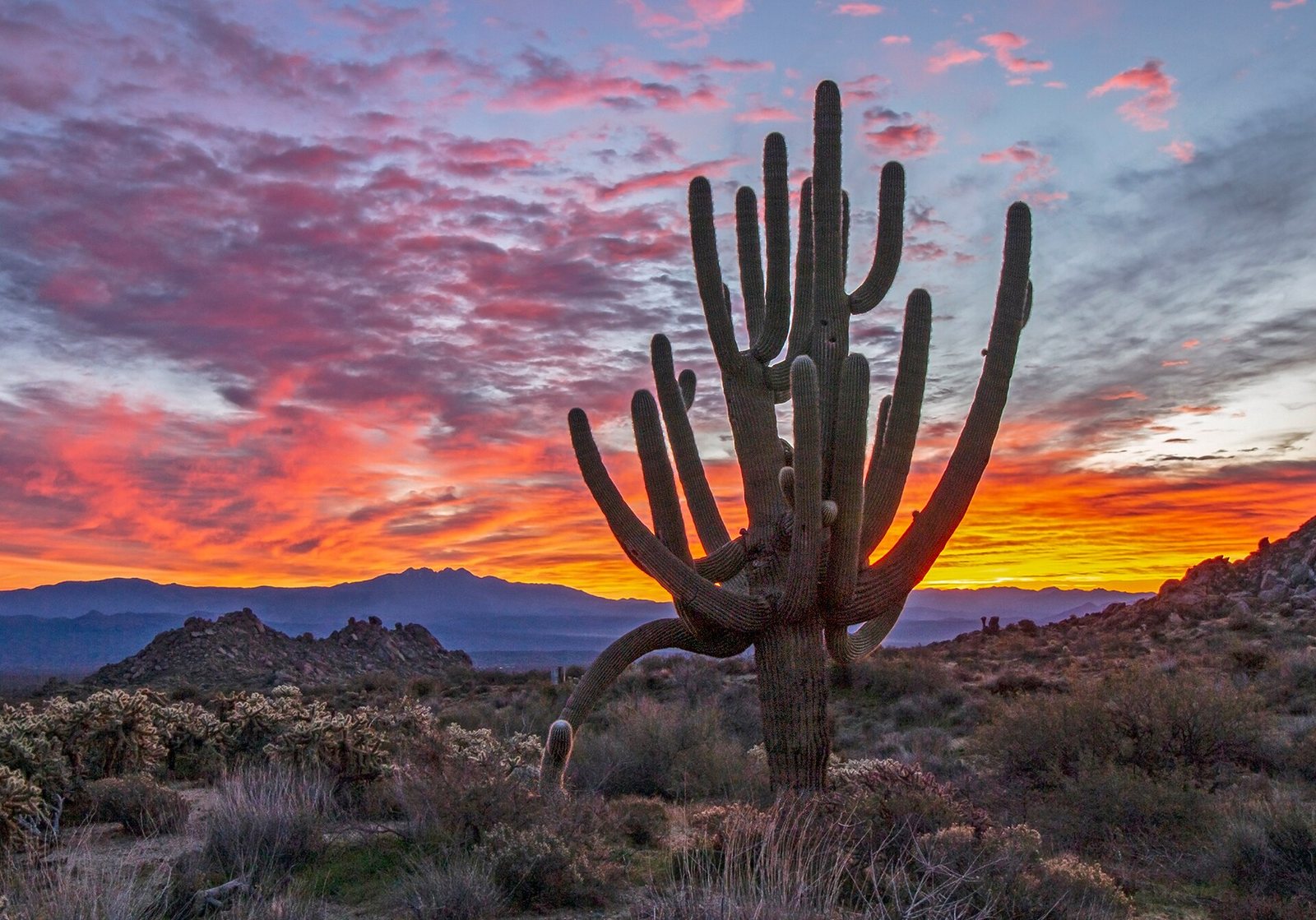
In spring 2026, a resort guest paid $309 for a round at We-Ko-Pa Golf Club, east of Scottsdale. From mid-June to late August the same round cost $109. Same course, same tee sheet, 65% off, and the reason was on the thermometer: the normal high at Sky Harbor climbs from 78.1°F in March to 106.5°F in July. Almost every price in the Valley follows that curve, from golf to garden tickets to resort rooms. So the best time to visit Phoenix is a trade between the weather you need and the price and crowds you will accept, and this guide works through it one month at a time.
Short answer: For most trips, go in March or November. Both have highs in the 70s, hiking weather all day and a full calendar. March is the most expensive and crowded month of the year, with spring training and spring break on top of each other, so November, early December and April are the value picks. June through September costs the least, but it only works if you plan to be outside at dawn and in a pool, a museum or a ballpark with a roof by 10 a.m.
Prices, hours, closures and event dates in this guide were last checked on September 24, 2026. Weather figures are NOAA’s 1991-2020 normals for Phoenix Sky Harbor unless a line says otherwise.
Phoenix month by month at a glance
The table puts the four things that matter side by side: temperature, daylight, price and crowds. For price, it uses one product whose rate card follows the season exactly: a resort-guest round at We-Ko-Pa, whose 2026 rates run from $109 to $309. Hotel and resort rates rise and fall on the same calendar, but they change daily, so a published golf rate is the cleaner yardstick.
| Month | Normal high / low (°F) | Days at 100°F+ | Sunrise / sunset (mid-month) | Price yardstick: We-Ko-Pa resort rate (2026) | Crowds (our read) | Verdict |
|---|---|---|---|---|---|---|
| January | 67.6 / 46.0 | 0 | 7:32 a.m. / 5:42 p.m. | $239 through Jan 7 | Busy | Great for hiking and museums; cool nights |
| February | 70.8 / 49.0 | 0 | 7:13 a.m. / 6:12 p.m. | $309 from Feb 9 | Very busy | The events month; book early |
| March | 78.1 / 54.5 | 0 | 6:40 a.m. / 6:35 p.m. | $309 | Busiest | Best weather, highest prices |
| April | 85.5 / 60.8 | 1.0 | 5:59 a.m. / 6:58 p.m. | $309, then $229 from Apr 27 | Busy, then easing | The sweet spot for pools plus morning hikes |
| May | 94.5 / 69.5 | 9.0 | 5:28 a.m. / 7:20 p.m. | $229, then $159 from May 18 | Moderate | Good value for early risers |
| June | 104.2 / 78.6 | 24.6 | 5:18 a.m. / 7:39 p.m. | $159, then $109 from June 15 | Light | Dry heat; the discounts begin |
| July | 106.5 / 84.5 | 28.5 | 5:29 a.m. / 7:39 p.m. | $109 | Light | Resort deals and monsoon storms only |
| August | 105.1 / 83.6 | 27.1 | 5:50 a.m. / 7:16 p.m. | $109, then $159 from Aug 28 | Light | Peak monsoon; an indoor trip |
| September | 100.4 / 78.1 | 18.2 | 6:11 a.m. / 6:36 p.m. | $159 | Light | Still summer; late-month value |
| October | 89.2 / 65.6 | 2.9 | 6:32 a.m. / 5:56 p.m. | $159 to Oct 11, $239 from Oct 23 | Moderate | Warm start, excellent finish |
| November | 76.5 / 53.7 | 0 | 6:59 a.m. / 5:27 p.m. | $239 | Moderate | The best value for top weather |
| December | 66.2 / 45.3 | 0 | 7:25 a.m. / 5:22 p.m. | $239 | Holiday peaks | Lights and museums; short days |
Sunrise and sunset are computed for downtown Phoenix on the 15th of each month. Arizona does not use daylight saving time, so those clock times hold all year without a spring-forward jump.
What is the best time to visit Phoenix?
Four things change through the Phoenix year, and they don’t peak together. Temperature is best from November through April. Prices are lowest from June through September. Crowds are heaviest from late January through March. And what is open, and when, shifts with the heat: some trails, tours and museum hours change in summer, while balloon sunset flights, Taliesin West’s daily schedule and the big festivals belong to the cool season.
The months that score well on all four are the edges of the cool season. November has a normal high of 76.5°F, no 100-degree days, a quieter calendar than spring and golf rates below the spring peak. April is warmer, at 85.5°F, but spring training is over and the pools are warm. Early December and late October are close behind. March has the best weather of all, and everyone knows it: March 2026 was the busiest month in Sky Harbor’s history, with 5,128,429 passengers.
If money matters more than comfort, the answer flips to summer, with a condition attached. From mid-June to late August the golf rates quoted in this guide run 52% to 66% below spring’s, and resorts discount on the same calendar. You buy that discount with your afternoons. The sun rises at 5:18 a.m. in mid-June, the city restricts its busiest summit trails from 8 a.m. to 5 p.m. whenever the National Weather Service issues an Extreme Heat Warning, and July’s normal low is 84.5°F, so evenings bring little relief. A summer trip works as a pool-and-museum trip with a dawn hike or two. It doesn’t work as a hiking trip.
Holidays move the calendar too. Thanksgiving falls on November 26, 2026, and Easter on March 28, 2027, a few days after the Cactus League’s last game on March 23. The Heard Museum closes on Easter Sunday, Thanksgiving and Christmas; Taliesin West closes on the same three days; and the S’edav Va’aki Museum also closes on New Year’s Day, Memorial Day, Juneteenth, July 4 and Labor Day. None of that ruins a trip, but it can ruin the one day you planned around a museum.
The best months by type of trip
| Trip | Best months | Why (checked Sept 2026) | Avoid |
|---|---|---|---|
| Hiking | November to March | Highs of 66-78°F; trails usable sunrise to sunset | June to September |
| Golf in ideal weather | November, January to April | Highs in the 60s and 70s on green, overseeded courses | October overseeding weeks |
| Golf on a budget | Late May to mid-September | Summer rates 52-66% below spring at the courses in this guide | February and March |
| Spring training | February 19 to March 23, 2027 | 15 teams, 229 games, 10 ballparks | Nothing; book early |
| Pools and resort deals | June to August | The lowest rates of the year | March |
| Museums | Any month; summer for value | Air-conditioned, with shorter summer hours at a few | Heard Museum Mondays in June to August |
| Big events | January to March | WM Phoenix Open, NBA All-Star, Renaissance Festival | Summer, which is quiet |
| Holiday lights | Late November and December | Luminarias and ZooLights | Christmas week if you want bargains |
| Storm watching and photography | July and August | Monsoon lightning, dust walls and sunsets | June, the driest month |
| Good weather, fewer crowds | Early November, early December, late April | Between the peaks | March |
When is the best time to hike in Phoenix?
From November through March you can hike at any hour a trail is open, and the limit is parking, not heat. Camelback’s trails are open from sunrise to sunset, and the city says the Echo Canyon lot typically fills from late morning to early afternoon on winter and spring weekdays and all day on weekends, so even in January the best time to start is early. Piestewa Peak’s trails open at 5 a.m. South Mountain’s trails keep the same 5 a.m. to 11 p.m. hours, though its park road and parking lots close at 7 p.m.
From April on, you are racing the sun. The Piestewa Peak Summit Trail climbs 1,200 feet in 1.2 miles and Camelback’s Echo Canyon Trail 1,400 feet in 1.14 miles, both with almost no shade, so on a 95-degree May morning you want to be back at the car by 9. From June through September, the only sensible hiking window is first light, and on Extreme Heat Warning days those summit trails close at 8 a.m. anyway. Dogs are banned from city trails whenever it is above 100°F, and never allowed on Camelback or the Piestewa summit trail at all.
When is the best time to golf in Phoenix?
Golf season follows the grass as much as the weather. Most Valley courses are Bermuda grass, which goes dormant and brown in winter, so each fall they overseed with ryegrass and close for a couple of weeks while it grows in. That makes October the month to check before you book: the City of Phoenix’s courses reopened between October 20 and November 3 in 2025, and We-Ko-Pa’s 2026 rate card simply skips from October 11 to October 23. From November through April the courses are green and the weather is ideal, and you pay for both, with We-Ko-Pa’s resort rate at its $309 peak from February 9 to April 26. The bargains run from late May to mid-September, when the same round costs $109 to $159 and the city’s Aguila course charges $33 to walk on a weekday (2026 rates). Summer golfers tee off at dawn and are done by late morning.
How can you see Phoenix cheaply in peak season?
The Desert Botanical Garden’s Community Day, on the second Tuesday of every month, is pay what you can, with suggested amounts of $5, $10 or $15 (checked September 2026). Two of the big museums have evening deals every month of the year: the Phoenix Art Museum is pay what you wish on Wednesdays from 3 to 8 p.m., and the Heard Museum costs nothing on First Friday evenings from 4 to 8 p.m. The mountain preserves and their sunsets never cost anything. Build one or two of those into a March trip and they take some of the sting out of the hotel bill.
Phoenix weather by month
Phoenix is dry, sunny and hot, but the numbers are more interesting than the reputation. The normal year at Sky Harbor brings 7.22 inches of rain, 111 days at 100°F or hotter and less than one night at freezing. The daily swing between high and low runs about 21 to 26 degrees, so a 70-degree afternoon in February can come after a 49-degree morning.
| Month | High (°F) | Low (°F) | Rain (inches) | Days with 0.1 inch+ of rain | Days at 90°F+ | Days at 100°F+ |
|---|---|---|---|---|---|---|
| January | 67.6 | 46.0 | 0.87 | 2.2 | 0 | 0 |
| February | 70.8 | 49.0 | 0.87 | 2.1 | 0 | 0 |
| March | 78.1 | 54.5 | 0.83 | 1.7 | 2.1 | 0 |
| April | 85.5 | 60.8 | 0.22 | 0.7 | 10.2 | 1.0 |
| May | 94.5 | 69.5 | 0.13 | 0.4 | 23.6 | 9.0 |
| June | 104.2 | 78.6 | 0.02 | 0.1 | 29.4 | 24.6 |
| July | 106.5 | 84.5 | 0.91 | 2.0 | 30.8 | 28.5 |
| August | 105.1 | 83.6 | 0.93 | 2.4 | 30.7 | 27.1 |
| September | 100.4 | 78.1 | 0.57 | 1.2 | 28.4 | 18.2 |
| October | 89.2 | 65.6 | 0.56 | 1.1 | 16.8 | 2.9 |
| November | 76.5 | 53.7 | 0.57 | 1.2 | 1.4 | 0 |
| December | 66.2 | 45.3 | 0.74 | 2.1 | 0 | 0 |
Three patterns in that table change how you should plan. First, the rain. Most people assume the summer monsoon is Phoenix’s wet season, but December through March brings 3.31 inches on average and July through September 2.41. Winter rain comes as gray, cool days that can wash out a hike; summer rain comes as short, violent afternoon storms. Second, the shoulder months are lopsided. April averages one 100-degree day, but May averages nine and October almost three, and the average last 100-degree day is October 5, according to the National Weather Service’s Phoenix records. Third, it is never really cold. The coolest normal high is December’s 66.2°F, and the coldest normal low is 45.3°F.
Phoenix month by month
Each month below has the numbers that decide a trip: the normals, the daylight, the prices, what’s on, what’s closed and a verdict.
January in Phoenix: cool, clear and busy
January’s normal high is 67.6°F and its low 46.0°F. Rain falls on about two days, and Sky Harbor averages 0.4 nights at or below freezing, which makes January the one month when frost is even a possibility. Mid-month the sun rises at 7:32 a.m. and sets at 5:42 p.m., which gives you about ten hours of light, every one of them usable for hiking.
This is the month for long trail days on Camelback, Piestewa Peak and South Mountain with no heat rules to think about, and for museums at their full winter hours. Taliesin West, Frank Lloyd Wright’s desert home in north Scottsdale, is open daily, and its weekend Apprentice Shelter Hike starts January 2, 2027, at $65 (checked September 2026). Golf is in high season: We-Ko-Pa’s resort-guest rate is $239 through January 7, and the City of Phoenix’s courses charged $69 to $74 to walk Aguila in winter 2026.
Crowds build through the month. Barrett-Jackson’s collector-car auction fills WestWorld of Scottsdale in late January, the Suns are in mid-season downtown, and seasonal visitors are settled in for the winter. Verdict: excellent for hikers, golfers and museum trips. Pack a jacket for evenings in the 40s, and don’t plan a pool day around January.
February in Phoenix: the events month
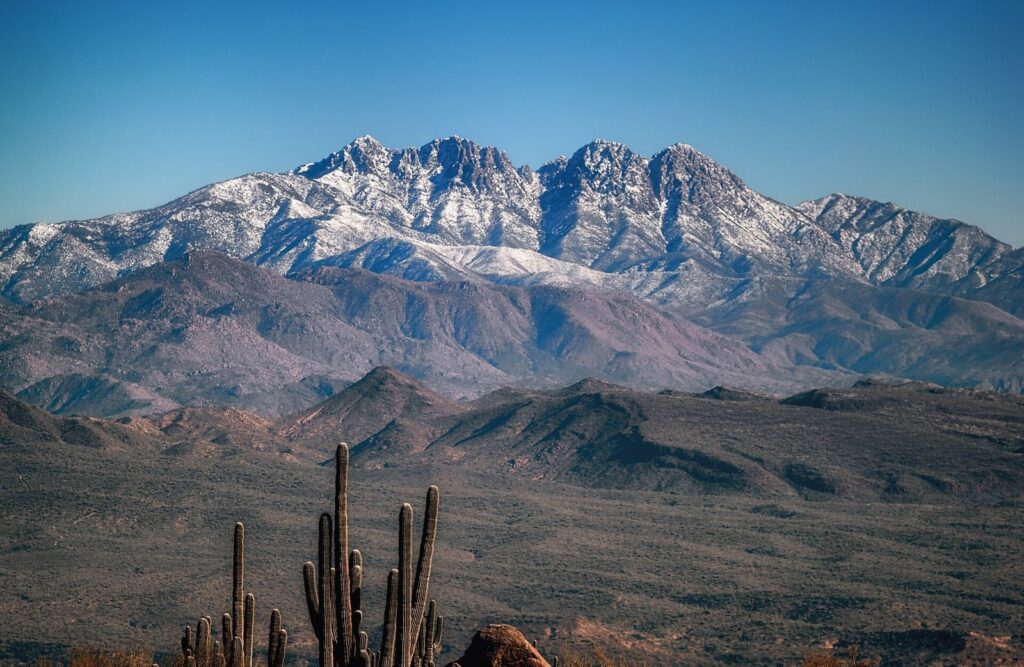
February’s normal high is 70.8°F and its low 49.0°F, with about two rainy days. The sun rises at 7:13 a.m. and sets at 6:12 p.m. mid-month, so the evenings open up. The weather is nearly as good as March’s, and the calendar is busier than any other month’s.
In 2027 the Heard Museum’s World Championship Hoop Dance Contest runs February 6-7. The Arizona Renaissance Festival in Gold Canyon opens February 6 and runs weekends through April 4, plus Presidents’ Day, with adult tickets at $39. The WM Phoenix Open takes over TPC Scottsdale February 8-14. The Cactus League opens February 19, and NBA All-Star Weekend lands at Mortgage Matchup Center downtown February 19-21 (all checked September 2026). We-Ko-Pa’s top rate of $309 started February 9 in 2026.
Verdict: the best month for events and nearly the best for weather, and the worst for bargains. If your trip overlaps the Open or All-Star weekend, book rooms and cars early and expect Scottsdale and downtown Phoenix to fill first.
March in Phoenix: the best weather, at the highest price
March’s normal high is 78.1°F and its low 54.5°F, with two days in the 90s on average and none at 100. Days and nights are close to even: sunrise at 6:40 a.m., sunset at 6:35 p.m. mid-month. Spring wildflowers usually peak in March and April, how many depends on winter rain, and the desert is as green as it gets.
Everyone wants this month. The Cactus League plays through March 23, 2027, with 15 teams at 10 ballparks, and the league says about six in ten fans come from out of state. The Heard Museum Guild Indian Fair and Market runs March 6-7, 2027, the Renaissance Festival continues on weekends, and spring break adds families. March 2026 was the busiest month in Sky Harbor’s history, with 5,128,429 passengers, and hotel rates reflect it.
Heat can arrive early. The earliest 100-degree day on record came on March 26, 1988. Verdict: if you can afford it and book early, this is the best month to be here. If you can’t, come in November or April and get most of the weather for less.
April in Phoenix: the sweet spot
April’s normal high is 85.5°F and its low 60.8°F, and it is dry, with less than a quarter inch of rain. It averages one 100-degree day and ten in the 90s, most of them late in the month. The sun rises at 5:59 a.m. and sets at 6:58 p.m. mid-month, so a sunrise hike and a sunset swim fit in the same day.
Spring training is over, spring break fades after the first week or two, and the Diamondbacks’ regular season is underway at Chase Field, which has a retractable roof and air conditioning. The Renaissance Festival’s last weekend is April 3-4, 2027. Salt River Tubing opened its 2026 season on April 25. Taliesin West is open daily through April 30, the last day of its Behind-the-Scenes Tour season. We-Ko-Pa’s resort rate dropped from $309 to $229 on April 27 in 2026.
Verdict: the best all-round month for travelers who want warm pools and some hiking. Start hikes at sunrise from mid-April on and be off exposed trails by late morning.
May in Phoenix: summer arrives early
May’s normal high is 94.5°F and its low 69.5°F, with nine 100-degree days on average and almost no rain. The average first 100-degree day of the year is May 2. The sun rises at 5:28 a.m., and that is when your outdoor day should start.
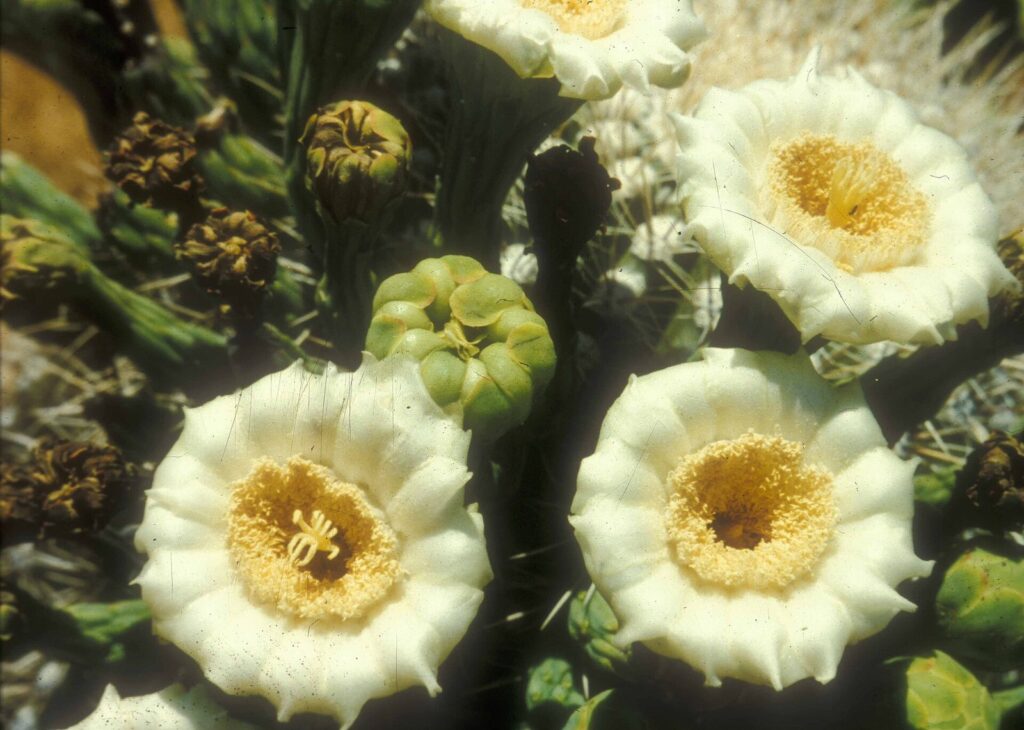
The city’s trail heat restrictions can begin this month: in 2024 it counted restriction days from May 1 onward. Taliesin West closes on Tuesdays in May 2027. Prices slide: We-Ko-Pa charged $229 through May 17, 2026, and $159 from May 18, and TPC Scottsdale’s Champions Course maximum guest rate fell from $109 in winter to $79 for most of May (checked September 2026). Saguaros bloom in late spring, when their white flowers, Arizona’s state flower, crown the arms of the big cactus.
Verdict: good value if you are an early riser and a pool person. Plan outdoor time from about 5:30 to 9 a.m., museums at midday and patios after sunset.
June in Phoenix: dry heat and the earliest sunrise
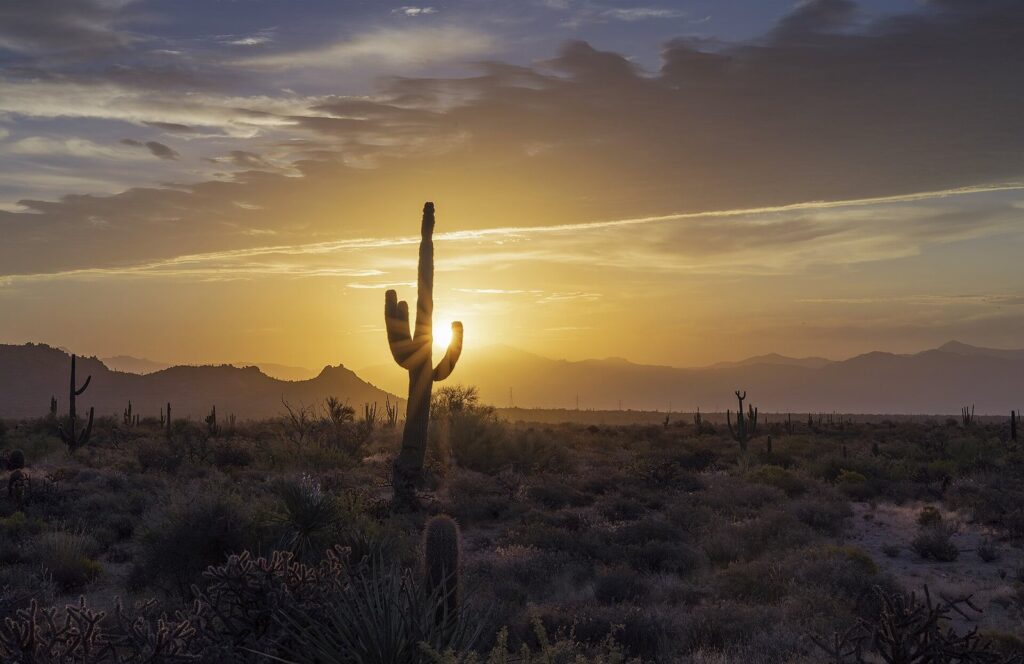
June’s normal high is 104.2°F and its low 78.6°F, with nearly 25 days at 100°F or more. It is also the driest month of the year, at 0.02 inch, so the heat is a dry one: brutal in the sun, almost pleasant in deep shade at 7 a.m. The average first 110-degree day is June 11, and Phoenix’s all-time record, 122°F, came on June 26, 1990. The sun rises at 5:18 a.m. and sets at 7:39 p.m.
The Heard Museum closes on Mondays from June through August. The Desert Botanical Garden ran a summer schedule in 2026 from 6 a.m. to 10 p.m., with its trails closed from 1 to 5 p.m. for the heat. Monsoon season officially begins June 15, though the storms usually hold off until July.
This is where the discounts start in earnest. City of Phoenix summer golf rates took effect June 1, 2026, with a weekday walking round at Aguila at $33 instead of $69. We-Ko-Pa dropped to $109 on June 15, and TPC Scottsdale’s Champions Course to $49 (all checked September 2026). Verdict: the cheapest good golf and resort time of year, if every outdoor plan ends by about 9 a.m.
July in Phoenix: the hottest month, and the storms begin
July’s normal high is 106.5°F, the hottest of the year, and its normal low is 84.5°F, so nights barely cool. It averages 28.5 days at 100°F or more. In 2023, Phoenix reached 110°F or higher on 31 days in a row, from June 30 to July 30. The monsoon usually arrives this month with 0.91 inch of rain on about two days, which doesn’t sound like much until a storm drops it in an hour.
Some places shut or shrink. Tovrea Castle runs no tours in July or August. The S’edav Va’aki Museum, the ancestral Hohokam village site near the airport, cuts back to 9 a.m.-2 p.m. on Mondays and Thursdays through Saturdays. City summit trails are off-limits from 8 a.m. to 5 p.m. on every Extreme Heat Warning day.
What stays open is everything indoors: museums, the Diamondbacks under Chase Field’s roof, the Mercury downtown and every resort pool in the Valley at its lowest rate of the year. Verdict: only for pool and resort deals, indoor sightseeing and storm watchers. Don’t come in July to hike.
August in Phoenix: peak monsoon
August’s normal high is 105.1°F and its low 83.6°F, with 27 days at 100°F or more. It is the wettest month by a hair, at 0.93 inch, and has the most rainy days, 2.4 on average. The average last 110-degree day is August 26. The sun rises at 5:50 a.m. and sets at 7:16 p.m.
August is when the monsoon’s dust storms, lightning and flash floods are most likely, and when the humidity makes 105 degrees feel worse than June’s dry 104. Arizona’s school year starts early in the month and Arizona State University’s students move in, so family travel thins out even as Tempe fills. Summer pricing holds until late in the month: We-Ko-Pa stayed at $109 until August 27, 2026, then rose to $159.
Verdict: a pool-and-museum trip with a front-row seat for the storms. Check the forecast every afternoon and keep a backup plan for evenings.
September in Phoenix: summer’s long tail
September’s normal high is 100.4°F and its low 78.1°F, and it still averages 18 days at 100°F or more. Monsoon season officially ends September 30. The sun rises at 6:11 a.m. and sets at 6:36 p.m., so evenings arrive sooner and the patios fill.
Prices stay low, and late September is where you see the season turn on the price tags. The Desert Botanical Garden charged adults $19.95 online from September 8 to 25, 2026, then $32.95 from September 26: the same garden, 65% more, a few days after the equinox. City summer golf rates ran through September 6. Salt River Tubing switched to Fridays through Sundays only from September 8, 2026, and closes for the season at the end of the month.
Verdict: still a summer month, whatever the calendar says. The last week of September is a good value window if you can live with 100-degree afternoons.
October in Phoenix: the season turns
October’s normal high is 89.2°F and its low 65.6°F, with about three 100-degree days, nearly all early in the month. The average last 100-degree day is October 5, but the latest on record was October 27, 2016, and in 2024 the city’s trail restrictions ran as late as October 13. The sun sets at 5:56 p.m. mid-month, a good hour earlier than in summer.
The fall calendar starts up. The Arizona State Fair runs Thursdays through Sundays in October. Taliesin West is closed on Tuesdays in October 2026 and open daily from November 1. Golf courses close in stages for fall overseeding: the city’s courses reopened between October 20 and November 3 in 2025, and We-Ko-Pa’s rate rises from $159 to $239 on October 23, 2026. Canyon Lake, east of Mesa, is closed this fall while Salt River Project draws it down about 54 feet for roughly 16 weeks from September 16, 2026.
Verdict: the first half is summer’s last stand and a value window; the second half is excellent. If you can choose, come after mid-month.
November in Phoenix: the value pick
November’s normal high is 76.5°F and its low 53.7°F, with about one rainy day and no 100-degree days. This is the month where the weather catches up with March’s, but the crowds and prices don’t. The one catch is the light: the sun sets at 5:27 p.m. mid-month, so plan sunset viewpoints around 5 p.m.
Everything reopens. Taliesin West is open daily from November 1 and starts its Behind-the-Scenes Tours on November 3, 2026. Afternoon and sunset hot-air balloon flights return, which operators run only from November to mid-March. The Desert Botanical Garden’s Community Day, on the second Tuesday, is pay what you can on November 10, and the Phoenix Art Museum’s Family Funday Sunday on November 15 is free (checked September 2026). ZooLights opens in late November, and the garden’s Las Noches de las Luminarias starts November 27.
Thanksgiving closes several museums, including the Heard, and fills the airport. We-Ko-Pa’s resort rate for November 2026 is $239, below the spring peak of $309. Verdict: the best value for top weather, especially in the first three weeks.
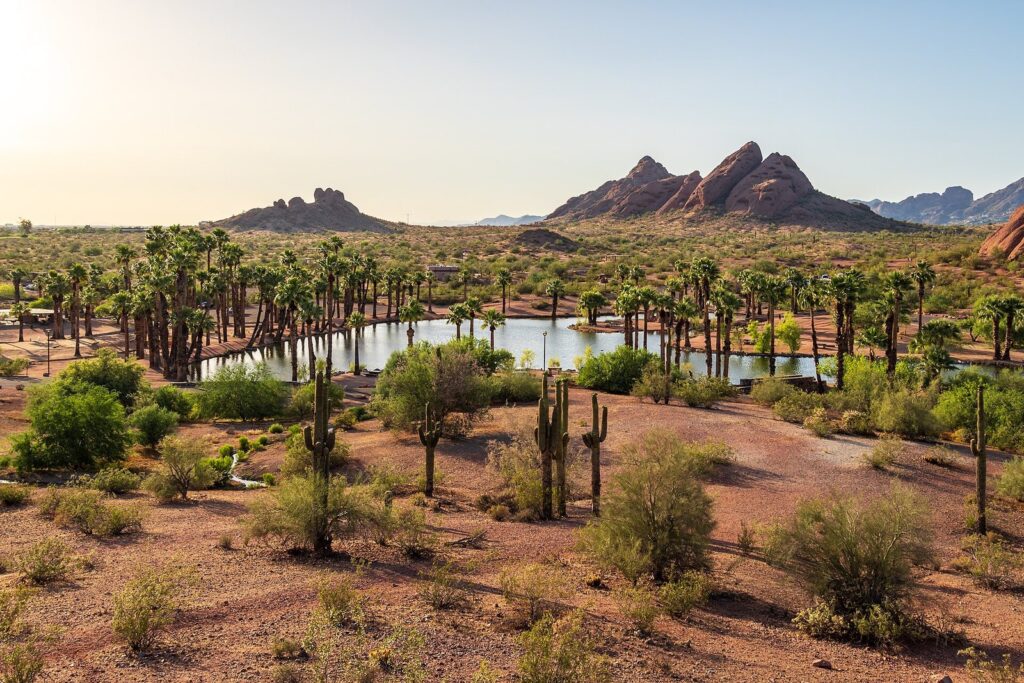
December in Phoenix: lights, short days and cool nights
December has the coolest normal high of the year, 66.2°F, and a low of 45.3°F. It averages about two rainy days, and the sun sets at 5:22 p.m. mid-month, the earliest of the year, so hiking days are short and dinner happens in the dark.
The holiday calendar makes up for it. Las Noches de las Luminarias lights the Desert Botanical Garden on 20 nights between November 27 and December 30, 2026, with the garden closing to day visitors at 4 p.m. on those dates and a separate ticket required. ZooLights runs at the Phoenix Zoo, Tempe’s fall arts festival fills Mill Avenue early in the month, and the Fiesta Bowl closes the year at State Farm Stadium in Glendale. Christmas Day closes several museums, including the Heard and Taliesin West.
Verdict: good for lights, museums and golf. The first two weeks are calmer and usually cheaper than the holiday stretch that follows.
Is spring or fall the better time to visit Phoenix?
They are mirror images with different trade-offs. Spring warms from March’s 78.1°F to April’s 85.5°F and ends with the first 100-degree days; fall cools from October’s 89.2°F to November’s 76.5°F and begins with the last ones. Spring has the long evenings, the green desert, the wildflowers and the Cactus League, and it charges for all of them: late February through March is the busiest and most expensive stretch of the year. Fall has shorter days, golf courses closing in turn for overseeding in October and a quieter calendar until the holiday lights start, and it costs noticeably less.
| Checked Sept 2026 | Spring (March-April) | Fall (late October-November) |
|---|---|---|
| Normal highs | 78.1°F to 85.5°F, warming | 89.2°F to 76.5°F, cooling |
| 100-degree days | None in March; about one in April | About three in October, mostly early |
| Sunset, mid-month | 6:35 to 6:58 p.m. | 5:56 p.m., then 5:27 p.m. |
| We-Ko-Pa resort rate (2026) | $309 until April 26 | $239 from October 23 |
| Crowds | The busiest weeks of the year | Moderate until Thanksgiving |
| Draws | Cactus League, wildflowers, Heard Indian Fair | State Fair, Taliesin West daily again, sunset balloon flights |
| Downsides | Prices and crowds | Short days; October overseeding |
Choose spring for events, daylight and baseball. Choose fall, and specifically the last week of October through the third week of November, for the best ratio of weather to price anywhere in the Phoenix year. If you are flexible about both, split the difference and come in April, when spring training’s crowds have gone and summer’s heat hasn’t arrived.
How much cheaper is Phoenix in summer?
A lot, and you can measure it. Resorts and hotels don’t publish fixed seasonal rates, but golf courses and some attractions do, and they show how steep the Valley’s price curve is.
| What you’re buying (2026 rates) | Peak price | Summer price | Summer saving |
|---|---|---|---|
| We-Ko-Pa round, resort-guest rate | $309 (Feb 9-Apr 26) | $109 (June 15-Aug 27) | 65% |
| We-Ko-Pa round, Arizona ID rate | $219 | $74 | 66% |
| TPC Scottsdale Champions Course, maximum guest rate | $109 (Jan 1-Apr 5) | $49 (June 1-Aug 26) | 55% |
| City of Phoenix Aguila Golf Course, weekday walking | $69 (Feb 2-May 31) | $33 (June 1-Sept 6) | 52% |
| Desert Botanical Garden, adult | From $32.95 (Oct 1-Dec 31) | $19.95 online (Sept 8-25) | About 40% |
Hotels follow the same calendar even if they don’t print it. Scottsdale’s own lodging report says about 43.6% of the city’s 2024 hotel sales tax came in January through April, and Scottsdale-area hotels averaged $271.17 a night over 2024, up about 30% from 2019’s $208.94, which makes the off-season discount worth more than it used to. From our reading of the rate cards, the curve has three steps: peak from February to April, a shoulder in May and again from late August to mid-October, and the floor from mid-June to late August.
The summer saving is real, but it comes with conditions. Sunrise hot-air balloon flights run year-round, but the afternoon and sunset flights stop from mid-March to October. Some tours stop entirely, and most outdoor activity has to be done by mid-morning. The best summer trip is built around what the discount buys: a better resort than you’d book in March, a round of golf at dawn and afternoons indoors.
What closes or changes with the seasons?
These are the schedule changes most likely to trip up a visitor. Dates are for 2026-27 and were checked in September 2026.
| Place or activity | What changes | When |
|---|---|---|
| City summit trails: Echo Canyon and Cholla on Camelback, Piestewa Peak Summit, South Mountain’s Holbert, Mormon and Hau’pal Loop, National Trail from Pima Canyon | Off-limits 8 a.m.-5 p.m. on Extreme Heat Warning days | Mostly May to October; 45 days in 2024 |
| Dogs on City of Phoenix trails | Banned above 100°F; never allowed on Camelback or the Piestewa Summit Trail | All year |
| Desert Botanical Garden | Summer hours of 6 a.m.-10 p.m. with trails closed 1-5 p.m.; 4 p.m. closing on Luminarias nights | Through Sept 30, 2026; 20 nights Nov 27-Dec 30, 2026 |
| Heard Museum | Closed Mondays | June 1-Aug 31 |
| Taliesin West | Closed Tuesdays | October 2026 and May 2027; daily Nov 1-Apr 30 |
| Tovrea Castle tours | No tours; also closed Mondays and Tuesdays all year | July and August |
| S’edav Va’aki Museum | Short hours, 9 a.m.-2 p.m., four days a week | July and August |
| Hot-air balloons | Afternoon and sunset flights offered only in the cool season | November to mid-March |
| City of Phoenix golf | Summer rates, then fall overseeding closures | June 1-Sept 6, 2026; October |
| Salt River Tubing | Seasonal; Fridays to Sundays only from early September | April 25 to late September in 2026 |
| Canyon Lake | Closed for an SRP drawdown | From September 2026 into January 2027 |
| Arizona Renaissance Festival | Open weekends plus Presidents’ Day | Feb 6-Apr 4, 2027 |
| Cactus League | Spring training games | Feb 19-Mar 23, 2027 |
The trail rule is the one to take seriously. On an Extreme Heat Warning day, the restricted trails are off-limits from 8 a.m. to 5 p.m., and the city’s heat-safety page lists them. Fewer than 7 of South Mountain’s 100-plus trail miles are covered, so easier trails elsewhere in the preserves stay open, but the famous summit climbs are the ones that close.
When is monsoon season in Phoenix, and what is it like?
The National Weather Service treats June 15 to September 30 as monsoon season. In practice June is the driest month of the year, and the storms arrive in July and August, when moist air from the south meets the desert heat. July, August and September together average 2.41 inches of rain at Sky Harbor, less than the 3.31 inches of December through March, so the monsoon is not a rainy season in the tropical sense. It is a season of occasional, violent afternoon and evening storms.
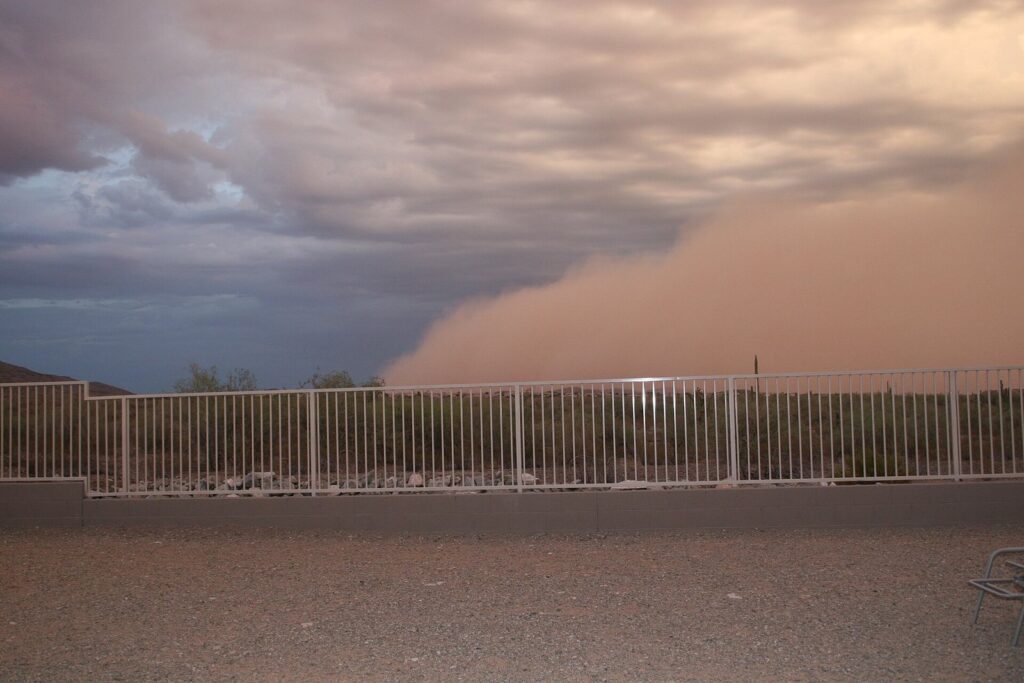
What it brings: lightning that lights up the whole sky, gusty winds, sudden downpours that flood low roads and dry washes within minutes, and dust storms, the walls of blowing dust locals call haboobs, which can cut visibility on the freeways to almost nothing. The Arizona Department of Transportation’s advice if one catches you driving is to pull off the road as far as you can, turn off your lights and wait it out. Storm days are also more humid, which makes 105°F feel worse than June’s dry heat.
For a visitor, the monsoon changes the shape of the afternoon more than the trip. Mornings are usually clear. Storms tend to build over the mountains in the afternoon and roll into the Valley toward evening, which is when the sunsets turn spectacular. Plan outdoor time early, keep the late afternoon flexible and never drive into a flooded road or wash.
How hot does Phoenix get?
Hotter than it used to. The 1991-2020 normals give Phoenix 111 days a year at 100°F or more and 21 at 110°F or more, but recent summers have blown past those numbers. In 2024, the warmest year on record in Phoenix, the city reached 100°F on 143 days, including a record 113 in a row from May 27 to September 16, and hit 110°F on 70 days. The most 100-degree days in a single year is 145, in 2020, and the all-time high is 122°F, on June 26, 1990 (National Weather Service records).
The heat has a predictable season. The average first 100-degree day is May 2 and the average last is October 5; the average first 110-degree day is June 11 and the last is August 26. Plan an outdoor trip outside those windows and the heat is a detail. Plan inside them and it decides your day.
That is why summer in Phoenix runs on an inverted schedule. The sun rises at 5:18 a.m. in mid-June, and the best hour of the day is the first one. Hike at dawn, go to a museum or the mall by mid-morning, rest through the afternoon, swim or eat once the sun drops, and save the late walk for after dark, when temperatures can still sit in the 90s. The Desert Botanical Garden’s summer schedule opened at 6 a.m. and closed its trails from 1 to 5 p.m. in 2026, which is a good model for any summer day here.
What to skip when you pick your dates
- Skip June through September for a hiking trip. Dawn hikes are possible, but the famous summit trails close from 8 a.m. to 5 p.m. on Extreme Heat Warning days, and there were 45 of those restriction days in 2024.
- Skip booking late February or March without checking the calendar. The WM Phoenix Open, NBA All-Star Weekend, spring training and spring break stack up inside six weeks in 2027. Book early or pick November.
- Skip assuming October 1 means fall. The average last 100-degree day is October 5, and the city’s trail restrictions ran to October 13 in 2024. Come after mid-month for real fall weather.
- Skip December if you want long outdoor days. Highs average 66°F and the sun sets at 5:22 p.m. It’s lovely weather, but there isn’t much of it.
- Skip planning around monsoon rain. The storms are short and mostly late in the day. Plan around the heat and the humidity instead, and keep evenings flexible.
- Skip a summer sunset balloon flight. Operators fly afternoons and sunsets only from November to mid-March. In summer, it’s sunrise or nothing.
- Skip Canyon Lake this fall. It is closed for Salt River Project’s drawdown from September 2026 into January 2027. Saguaro Lake is the nearby alternative.
Frequently Asked Questions
What is the best month to visit Phoenix?
March has the best weather, with a normal high of 78.1°F and the fullest calendar, but it is also the busiest and most expensive month; March 2026 set Sky Harbor’s all-time passenger record. November is the best value, with a normal high of 76.5°F, fewer crowds and lower rates. April and early December are close runners-up.
What is the cheapest time to visit Phoenix?
June through August. Prices drop across the Valley once highs pass 100°F: in 2026 a resort-guest round at We-Ko-Pa fell from $309 in spring to $109 from mid-June, and City of Phoenix golf fees roughly halved. Hotels and resorts follow the same curve, but you will need to finish outdoor plans by about 9 a.m.
When is monsoon season in Phoenix?
Officially June 15 to September 30. Most storms come in July and August, which average about 0.9 inch of rain each at Sky Harbor. Expect afternoon or evening thunderstorms, lightning, dust storms and flash flooding in washes, with humid mornings in between. Winter actually brings more rain: about 3.3 inches from December through March.
How hot is Phoenix in the summer?
Normal highs are 104.2°F in June, 106.5°F in July and 105.1°F in August, and July’s normal low is 84.5°F. Phoenix averages 111 days a year at 100°F or more and 21 at 110°F or more. In 2024 it reached 100°F on 143 days, including 113 in a row, and 110°F on 70 days.
Is Phoenix worth visiting in the summer?
Yes, if you plan around the heat. Resort and golf prices are at their lowest, museums are air-conditioned and the Diamondbacks play under Chase Field’s roof. Hike only at sunrise, which comes as early as 5:18 a.m. in June, and expect city summit trails to close from 8 a.m. to 5 p.m. on Extreme Heat Warning days.
What is Phoenix weather like in winter?
Mild days and cool nights. December and January highs average 66°F to 68°F and lows about 45°F to 46°F, and frost is rare, with less than one freezing night a year at Sky Harbor on average. Winter storms bring about two wet days a month, and the sun sets as early as 5:22 p.m. in December.
Does Phoenix use daylight saving time?
No. Arizona stays on Mountain Standard Time all year, so from March to early November Phoenix shows the same clock time as Los Angeles, and in winter it matches Denver. The Navajo Nation in northeastern Arizona does observe daylight saving time. Without it, summer sunrises in Phoenix come as early as 5:18 a.m.
When is spring training in Phoenix?
In 2027, Cactus League games run from Friday, February 19, to Tuesday, March 23, with 15 teams playing 229 games at 10 ballparks around the Valley. Those five weeks overlap spring break and follow the WM Phoenix Open, so hotels near the parks fill early. About six in ten fans come from out of state.
Sources and verification
This guide is built from research, not hosted visits. Weather normals, records, prices, hours, closures and event dates were checked on September 24, 2026, against the agencies and operators below. Sunrise and sunset times are computed with NOAA’s solar equations for downtown Phoenix.
- NOAA and the National Weather Service: 1991-2020 monthly normals for Phoenix Sky Harbor; Phoenix extreme temperature facts; 2024 year in review
- City of Phoenix: trail heat restrictions; trail rules; spring 2026 golf rates; summer 2026 golf rates; S’edav Va’aki Museum hours
- Golf courses: We-Ko-Pa Golf Club rates; TPC Scottsdale 2026 rate sheet
- Attractions: Desert Botanical Garden; Heard Museum hours, Hoop Dance Contest and Indian Fair and Market; Taliesin West; Tovrea Castle tours; Phoenix Art Museum free days
- Outdoors: Salt River Tubing; SRP Canyon Lake drawdown fact sheet; Rainbow Ryders; Hot Air Expeditions
- Events: Cactus League 2027 schedule; WM Phoenix Open; NBA All-Star 2027; Arizona Renaissance Festival
- Travel data: Phoenix Sky Harbor media kit; City of Scottsdale lodging statistics, August 2025
Photo Credits
- Four Peaks with snow: photo by Desertrat143, Wikimedia Commons (CC BY-SA 4.0)
- Saguaro blossoms: photo by SaguaroNPS, Wikimedia Commons (public domain)
- Summer heat-wave sunrise near Phoenix, 2023: photo by Ray Redstone, Wikimedia Commons (CC BY-SA 4.0)
- Papago Park: photo by dconvertini, Wikimedia Commons (CC BY-SA 2.0)
- Haboob over Ahwatukee: photo by John Jurik (Junebug172 at en.wikipedia), Wikimedia Commons (public domain)
- Saguaro at sunrise near Phoenix (featured image): photo by Ray Redstone, Wikimedia Commons (CC BY-SA 4.0)