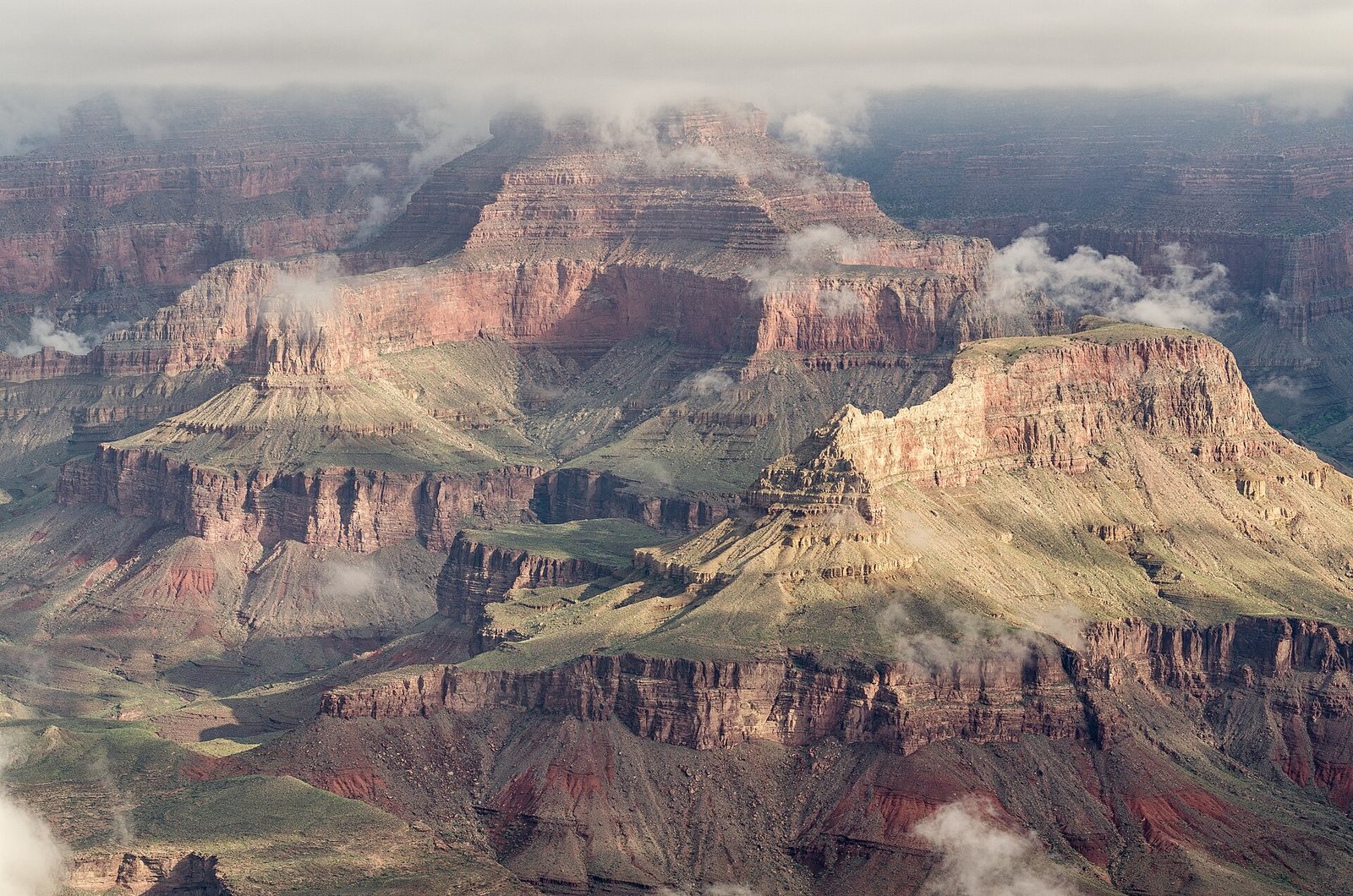
The Grand Canyon Visitor Center is 229 miles from downtown Phoenix by the fastest route, and with no traffic and no stops the drive takes 257 minutes. That is four hours and 17 minutes each way, not the “three and a half hours” most tour pages promise, and it means a day trip puts you in a car for eight and a half hours to spend three or four at the rim. The honest answer to getting to the Grand Canyon from Phoenix is arithmetic, and once you do it, the choice between a long day, a coach tour, the train and a night at the rim gets much easier.
Short answer: If you can, drive up, stay one night in or near the park, and see the South Rim at sunset and again at sunrise. If you only have one day, a coach tour from Phoenix or Scottsdale spares you the driving; operators describe 13- to 15-hour days with about three to four hours at the canyon. Skip Grand Canyon West unless you’re coming from Las Vegas: from Phoenix it’s a six-hour drive each way to a different, privately run rim.
Fees, shuttle schedules, train times and seasonal closures in this guide were last checked on September 24, 2026. Drive times are off-peak estimates from downtown Phoenix; weekend traffic on I-17 and entrance-station lines in busy months add more.
Grand Canyon from Phoenix at a glance
| Option | Time from Phoenix | Time at the canyon | Cost (checked Sept 2026) | Verdict |
|---|---|---|---|---|
| Self-drive day trip | About 4 hr 15 min each way | 3-5 hours | $35 per car entrance, plus fuel | Possible, exhausting |
| Self-drive with one night | About 4 hr 15 min each way | Sunset, sunrise and a full morning | $35 per car for 7 days, plus lodging | Best for most visitors |
| Coach tour from Phoenix or Scottsdale | 13-15 hour day, per operators | About 3-4 hours | Varies by operator | Good if you won’t drive |
| Grand Canyon Railway from Williams | About 3 hours’ drive to Williams, then the train | More than 3 hours | Fares vary by class | Best as part of an overnight |
| Grand Canyon West (Hualapai) | About 6 hours each way | A few hours | Separate tribal tickets; Skywalk extra | Skip from Phoenix |
| North Rim | Much longer, via a different route | Seasonal | Lodge destroyed in 2025; campground to Oct. 15, 2026 | Not from Phoenix this year |
How far is the Grand Canyon from Phoenix?
The National Park Service gives the distance as 231 miles to the South Rim, by I-17 north to Flagstaff, I-40 west to Williams and AZ 64 north into the park. Our routing, measured in September 2026, puts the fastest trip from downtown Phoenix to the Grand Canyon Visitor Center at 257 minutes and 229 miles. The routes differ by only a few minutes, so pick the one that fits the rest of your trip.
| Route from downtown Phoenix (off-peak, Sept 2026) | Time | Miles |
|---|---|---|
| Fastest, to the Grand Canyon Visitor Center | 257 min | 229 |
| Via Williams and AZ 64 (the NPS route) | 261 min | 219 |
| Via Flagstaff and US 180 through the forest | 268 min | 232 |
| Via Cameron to the Desert View entrance | 269 min | 230 |
| To Tusayan, just outside the South Entrance | 242 min | 222 |
| To the Grand Canyon Railway depot in Williams | 182 min | 160 |
| From Sky Harbor Terminal 4 to the Visitor Center | 264 min | 234 |
The “three and a half hours” figure you see on tour and road-trip pages is optimistic even before you stop. Add a fuel and restroom stop, a slow stretch on I-17’s mountain grades, and a line at the South Entrance on a busy morning, and four and a half hours each way is a more realistic plan. The east entrance at Desert View, reached via Cameron, is a good choice if you want to see the Desert View Watchtower first and drive the 25-mile Desert View Drive to Grand Canyon Village, which takes about 45 minutes.
Which route is the nicest drive?
All three routes start the same way, with two hours on I-17 climbing out of the desert onto the Colorado Plateau. After Flagstaff they part ways, and each has a different character.
US 180 from Flagstaff is the prettiest. It’s a two-lane road through ponderosa pine forest, curving around the base of the San Francisco Peaks, Arizona’s highest mountains, before dropping onto open grassland toward the park. It’s also the one most affected by snow; Flagstaff averages about 90 inches a year, and this road climbs higher than the others near town. In winter, check conditions or take the interstate.
I-40 to Williams and AZ 64 is the NPS’s recommended route and the most straightforward: interstate to Williams, then a mostly straight run north across high grassland to Tusayan and the South Entrance. It’s the one to take in bad weather or after dark.
US 89 to Cameron and the east entrance crosses the edge of the Painted Desert on the Navajo Nation and climbs to Desert View beside the gorge of the Little Colorado River. It’s the most varied scenery of the three and the best choice if you want to start at the Watchtower and work west along Desert View Drive.
Where should you stop on the drive from Phoenix?
Four hours is a long time in a car, and a couple of well-chosen stops make the drive part of the trip instead of something to endure.
Montezuma Castle National Monument. A five-story Sinagua cliff dwelling set into a limestone cliff, a short detour off I-17 about 104 minutes from downtown Phoenix. The paved loop takes under an hour, and entry is $10 per adult, children 15 and under free, with Tuzigoot National Monument included for 7 days (checked September 2026). It’s the best stop on the way up if you left early.
Sunset Point. The rest area on I-17 north of Black Canyon City has restrooms and a wide view west over the Bradshaw Mountains, roughly an hour into the drive. Ten minutes here is worth more than half an hour at a fast-food exit.
Flagstaff. At 155 minutes from Phoenix and 6,900 feet, Flagstaff is the natural lunch stop, with a walkable downtown on old Route 66 and more restaurants than anywhere between Phoenix and the rim. If you’re taking US 180 to the park, it’s directly on your way; Lowell Observatory, where Pluto was discovered, is on Mars Hill above downtown if you’re staying the night.
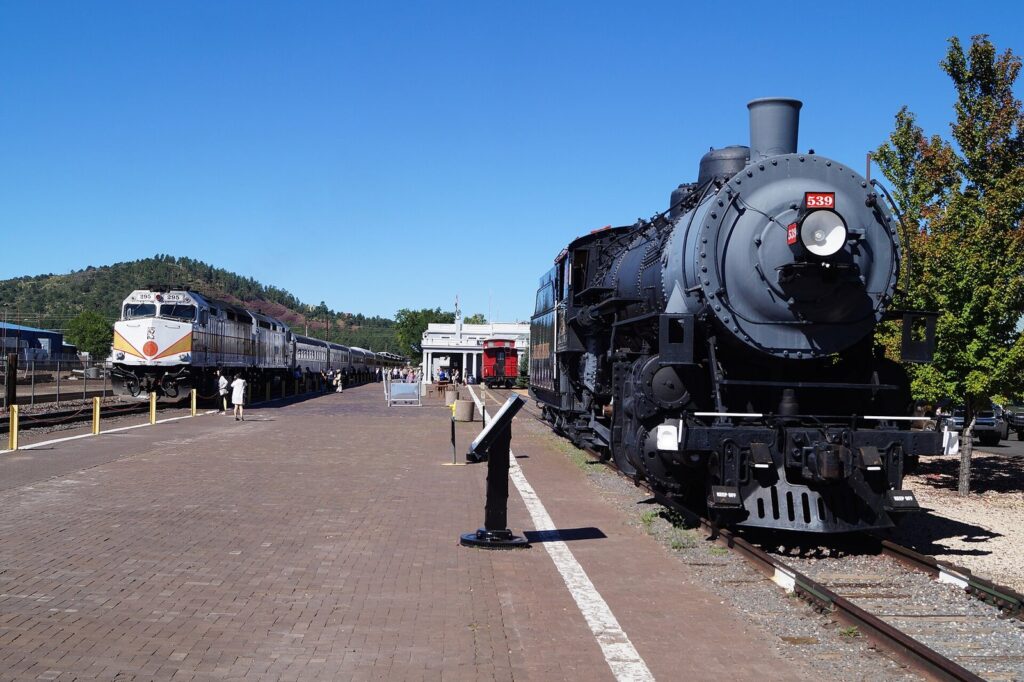
Williams. The Route 66 town 182 minutes from Phoenix is on the NPS route via I-40 and AZ 64, and home to the Grand Canyon Railway’s depot. Its main street of motels, diners and souvenir shops makes a good coffee stop even if you aren’t taking the train.
Cameron. If you go in through the east entrance, you’ll pass through Cameron on US 89, on the Navajo Nation, where a trading post has served travelers for about a century. From there AZ 64 climbs west along the canyon of the Little Colorado River to Desert View, with viewpoints along the way.
Can you do the Grand Canyon as a day trip from Phoenix?
You can, and plenty of people do, but it is a very long day. Here is what it looks like with a sensible start.
| Time | What happens |
|---|---|
| 5:00 a.m. | Leave downtown Phoenix |
| About 9:30 a.m. | Reach the South Entrance after one stop; pay $35 per car |
| 9:45 a.m.-3:00 p.m. | Mather Point, the Rim Trail, Grand Canyon Village, a shuttle to Hermit Road or a drive to Desert View |
| 3:00 p.m. | Start back |
| About 7:30 p.m. | Home, with at least four hours of driving behind you and dinner still ahead |
That gives you about five hours at the canyon and eight and a half on the road, and it skips the best part of any visit: the late-afternoon and early-morning light, when the canyon’s walls turn red and gold. Stay for sunset, which comes at 7:46 p.m. at Grand Canyon Village in mid-June and 5:54 p.m. in mid-October, and you drive four-plus hours home in the dark on I-40 and I-17, where elk and deer cross at night and fatigue is the real danger.
Verdict: a day trip is fine if it’s truly your only option, and far better than not going. But if you can spare one night, the same drive buys you sunset, sunrise and a relaxed morning on the rim, and it’s a completely different trip.
Is a Grand Canyon tour from Phoenix worth it?
For travelers who don’t want to drive, yes. Operators that run South Rim day tours from Phoenix and Scottsdale describe days of 13 to 15 hours with hotel pickup, and about three to four hours at the canyon, typically spread across several viewpoints. Some small-group tours add a stop in Sedona on the way. You trade flexibility for a driver: you can sleep on the way home, and someone else handles the parking and the entrance line.
Before you book, check four things: whether the $35 park entrance fee (2026) is included, how many hours you’ll actually have at the rim, whether lunch is included or a stop at a cafeteria, and the size of the group. A small van gets to viewpoints faster than a full coach. And if the tour stops in Sedona too, expect less time at the canyon; that’s two major sights compressed into one long day.
Why should you stay overnight, and where?
Because the Grand Canyon is at its best when the sun is low. The walls glow at sunrise and sunset and look flat and hazy at noon, and a day trip spends almost all its time in the noon light. One night lets you watch sunset from the rim, eat without rushing, see sunrise and still have a morning before the drive home. And the entrance pass, $35 per car, is good for 7 days, so a second day costs nothing more at the gate.
Inside the park. The National Park Service lists South Rim lodging run by Xanterra, including El Tovar Hotel, Bright Angel Lodge, Kachina Lodge, Thunderbird Lodge and Maswik Lodge, plus Delaware North’s Yavapai Lodge and Trailer Village RV park. South Rim lodging is open all year and books up well in advance, especially for spring break, summer and fall weekends (checked September 2026). Sleeping on the rim means you can walk to sunset and back.
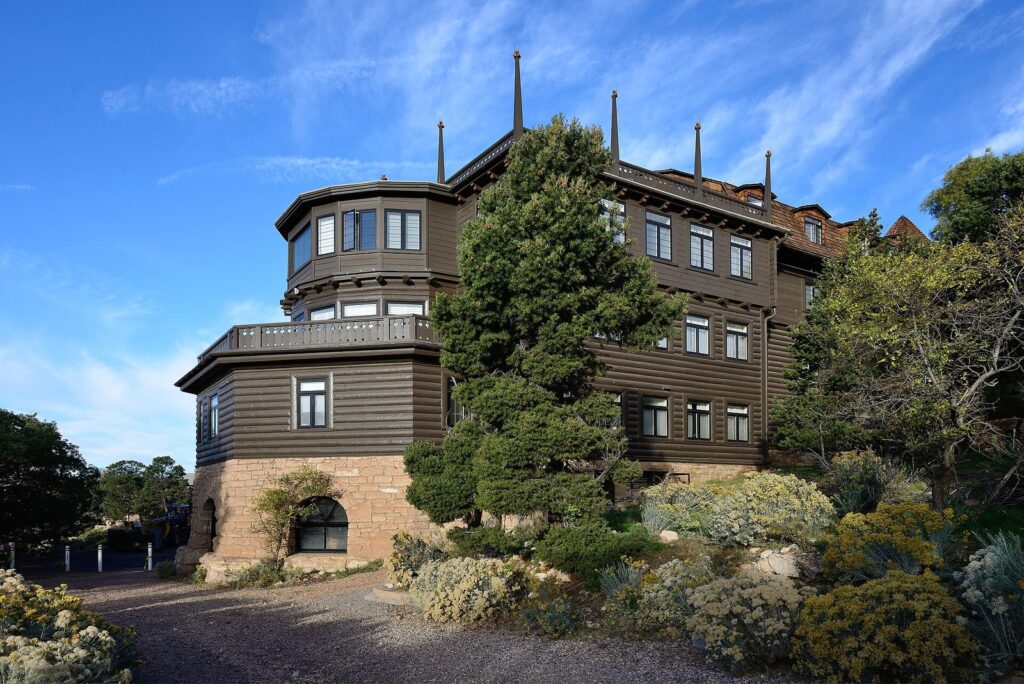
Tusayan. The small gateway town just outside the South Entrance, 242 minutes from downtown Phoenix and about 15 minutes from the Visitor Center, has chain hotels and restaurants and is the easiest fallback when the park is full.
Williams. A Route 66 town 182 minutes from Phoenix and about an hour and 20 minutes south of the rim, and the home of the Grand Canyon Railway. It’s the natural base if you’re taking the train.
Flagstaff. The biggest town nearby, 155 minutes from Phoenix and a little under two hours from the rim, with the widest choice of hotels and restaurants. Good for a trip that also includes Sedona.
What does a two-day Grand Canyon trip from Phoenix look like?
Two days with one night is the trip most Phoenix visitors should take. Here is a plan that uses the light well, built on the park’s fall 2026 shuttle schedule and mid-October sun times at Grand Canyon Village (sunrise about 6:34 a.m., sunset about 5:54 p.m.).
Day 1. Leave Phoenix at 7 a.m. and drive I-17 to Flagstaff for lunch around 9:45. Continue north on US 89 to Cameron and enter the park through the Desert View entrance early in the afternoon. Climb the Desert View Watchtower, then drive the 25 miles of Desert View Drive west toward the Village, stopping at two or three viewpoints along the way. Check into your room, park the car for the rest of the trip and be at the rim for sunset, at Mather or Yavapai Point, with a jacket, because the temperature drops fast once the sun goes.
Day 2. Get up for sunrise, which at the rim is quiet, cold and spectacular. After breakfast, walk the Rim Trail west through Grand Canyon Village, then take the free shuttle out along Hermit Road and hop off at the overlooks. If you want to see the canyon from below the rim, walk a short way down the Bright Angel Trail before it warms up and turn around early; the climb back is the hard part. Eat lunch in the Village, and start home by early afternoon via Williams and I-40, arriving in Phoenix by early evening.
In summer, shift the plan: the sun rises about 5:10 a.m. and sets about 7:46 p.m. in mid-June, so you get longer evenings at the rim and can leave Phoenix later on day one. In winter, check the road forecast before you go, and plan for sunset around 5:15 p.m. in mid-December.
How does the Grand Canyon Railway work?
The Grand Canyon Railway runs from Williams to the historic heart of Grand Canyon Village, and it’s a genuinely fun way to arrive, with western musicians and characters on vintage cars and a staged shootout before departure. The train leaves Williams daily at 9:30 a.m. (8:30 a.m. in November and December) and gets back at 5:45 p.m. (4:45 p.m. in November and December), which gives you more than three hours at the canyon. Fares depend on the class of service, and the railway offers a full refund on cancellations up to 14 days before departure (checked September 2026 on the railway’s site).
From Phoenix, Williams is 182 minutes away, so a same-day train trip means leaving Phoenix by about 5:45 a.m. to make a 9:30 departure with time to park, and getting home around 9 p.m. That works, but it’s a long day with a lot of sitting. The train is at its best as part of an overnight: sleep in Williams, ride up in the morning, and either ride back or spend a night at the rim. Families especially love it, and in winter the railway runs The Polar Express.
What should you see at the South Rim in one day?
Start at the Grand Canyon Visitor Center and walk five minutes to Mather Point, the classic first view. From there, the paved Rim Trail follows the edge west to Grand Canyon Village, past the Yavapai Geology Museum, the historic El Tovar and Bright Angel Lodge, and viewpoints every few hundred yards. It’s mostly flat, you can walk any section of it, and the free shuttle picks you up when you’re done.
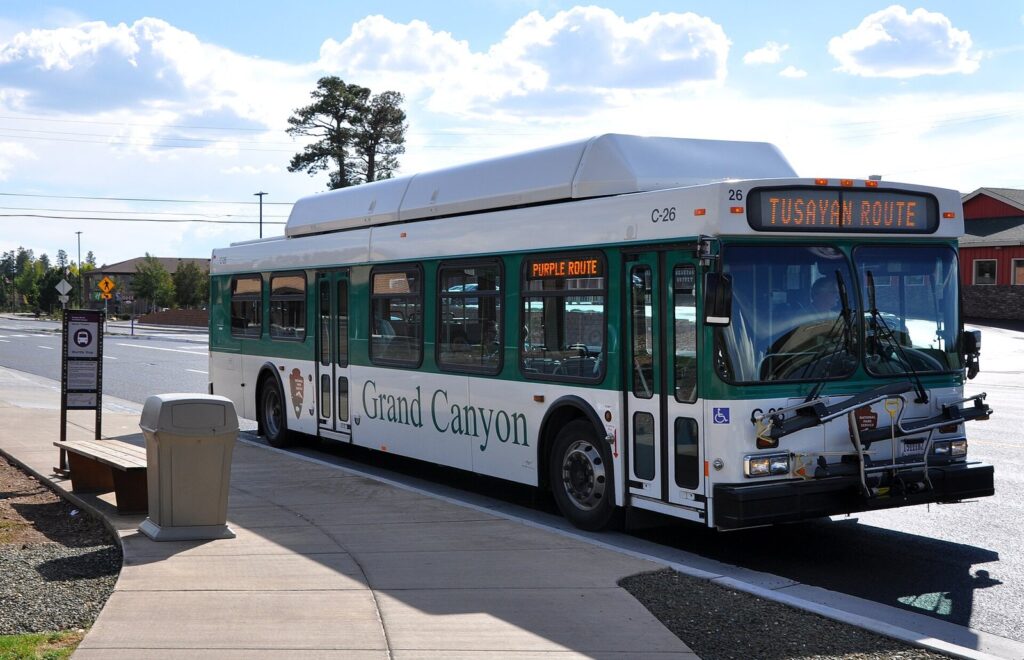
Hermit Road. West of the Village, Hermit Road runs 7 miles to Hermits Rest past some of the best viewpoints in the park, including Hopi Point, a favorite for sunset. For most of the year it’s closed to private cars and served by the free red-route shuttle, which is part of the point: you hop off at each overlook and walk the rim between stops.
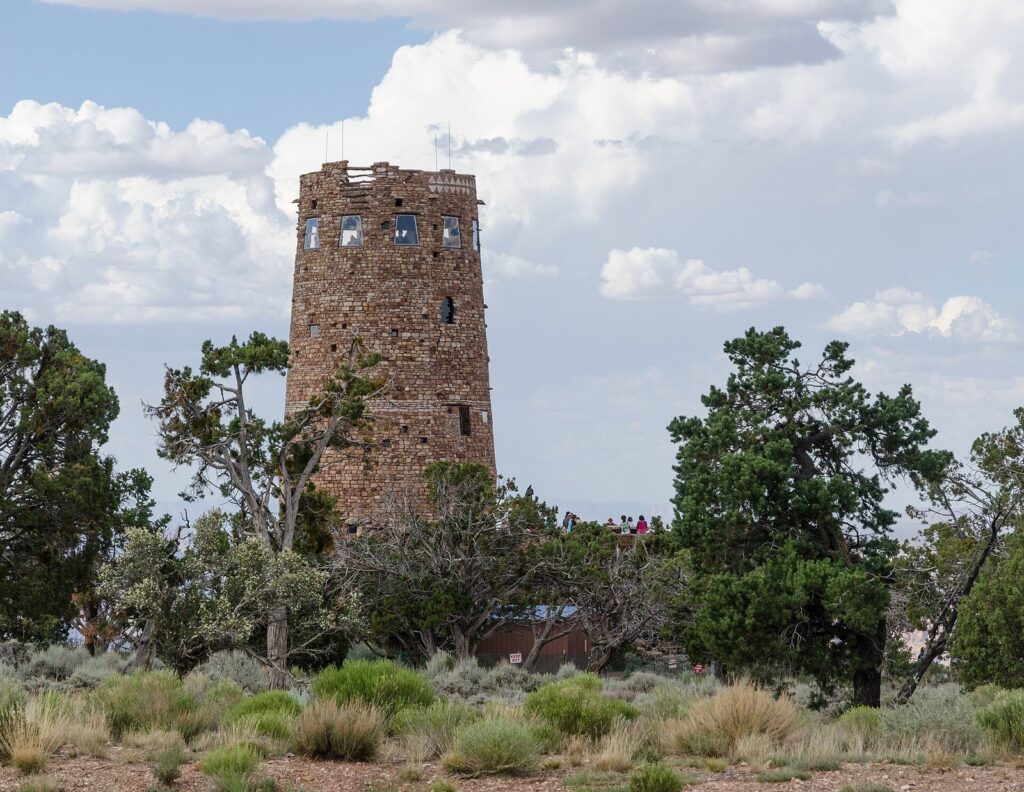
Desert View Drive. East of the Village, this 25-mile road runs past a string of viewpoints to the Desert View Watchtower, a stone tower designed by Mary Colter with painted interior walls and a view up the canyon toward the Painted Desert. It takes about 45 minutes to drive without stopping; with stops, allow two hours or more. If you enter from Cameron, you’ll see it first.
Below the rim, carefully. A short walk down the Bright Angel or South Kaibab trail shows you the canyon from inside, but it’s steep, the climb out takes twice as long as the walk down, and the inner canyon is far hotter than the rim. The park specifically warns hikers to avoid the inner canyon between 10 a.m. and 4 p.m. in hot weather, and its hot-weather guidance calls for about a quart of water per hour of hiking plus salty snacks. On a day trip, turn around well before you’re tired; rim-to-river hikes need serious planning that this guide doesn’t try to cover.
How do the South Rim shuttles work?
The park’s shuttles are free and included with your entrance fee. From September 12 through November 30, 2026, the park is running the Village (Blue) Route, the Kaibab Rim (Orange) Route, the early-morning Hikers’ Express and the Hermits Rest (Red) Route. The Village route takes 50 minutes round trip and runs every 15 minutes from 7 to 10 a.m., every 12 minutes from 10 a.m. to 7 p.m. and every 15 minutes from 7 to 9 p.m. The Kaibab Rim route runs every 20 minutes from 6 to 9 a.m., then every 15 minutes until an hour after sunset, stopping at the Backcountry Information Center, the Visitor Center and the South Kaibab Trailhead (checked September 2026). Park once and ride; driving between viewpoints on a busy day wastes time you drove four hours for.
Where are the best sunrise and sunset viewpoints?
Almost any overlook is beautiful in low light, but a few are famous for a reason. Mather Point and Yavapai Point, both close to the Visitor Center and each other, face a huge sweep of the canyon and are the easiest sunrise spots, especially if you’re staying in the Village. Hopi Point, on Hermit Road, juts out far enough to catch light both up and down the canyon and is the classic sunset crowd-pleaser; get there on the shuttle. On Desert View Drive, Lipan Point and the Desert View area look east up the canyon toward the Painted Desert, and are quieter at sunrise. Whichever you pick, arrive 30 minutes early: the best color often comes just before sunrise and just after sunset.
Where do you park and eat at the rim?
The Grand Canyon Visitor Center has the park’s largest parking lots, and the Village and Market Plaza areas have more. On a busy midday in spring or summer, all of them can fill, so arrive early or late, park once and use the free shuttles for everything else. Food is available in Grand Canyon Village and at Market Plaza, from lodge dining rooms and cafeterias to a general store with groceries and sandwiches, run by the park’s concessioners. Prices reflect the location, and lines peak at lunch, so a packed lunch or snacks from Flagstaff or Tusayan saves time on a day trip.
Is the South Rim good for kids and for visitors with limited mobility?
Yes, with care. For children, the park’s Junior Ranger program turns a day of viewpoints into a project, and the Grand Canyon Railway’s staged shootout and western musicians make the journey part of the fun. The canyon’s edge is the real hazard: much of the rim has no railing, and the drop is sheer, so hold hands at overlooks and keep children on the paved paths. Pack warm layers for kids too; at 6,882 feet mornings are cold even in summer.
For visitors with limited mobility, the South Rim is one of the more accessible big-name parks. The Rim Trail through the Village and around the Visitor Center is paved and mostly level, the shuttles are designed to carry wheelchairs, and the park issues accessibility permits that let eligible visitors drive some roads normally reserved for the shuttle. Ask at the Visitor Center when you arrive.
Will the altitude affect you?
You’ll probably notice it. Grand Canyon Village sits at 6,882 feet, almost 5,800 feet higher than Phoenix, and some visitors feel short of breath on stairs and slopes, get headaches or tire faster than expected, especially on the first day. Drink water, take the Rim Trail at an easy pace, and don’t plan a hard hike below the rim a few hours after arriving from the desert. The effect is usually mild at this height, but it’s one more reason to give the canyon a night rather than rushing it.
When is the best time to visit the Grand Canyon from Phoenix?
The South Rim’s climate is almost the opposite of Phoenix’s. Grand Canyon Village sits at 6,882 feet, nearly 5,800 feet higher than downtown Phoenix, so the rim is a summer escape and a winter snow zone. Its normal July high is 84.9°F, against 106.5°F in Phoenix, and its normal January high is 44.3°F with a low of 19.2°F (NOAA 1991-2020 normals).
| Season at the South Rim | Normal highs | What to expect |
|---|---|---|
| Spring (March-May) | 53.6°F-69.9°F | Cool mornings, busy spring break, occasional late snow |
| Summer (June-August) | 82.0°F-84.9°F | The busiest season; monsoon storms in July and August |
| Fall (September-November) | 75.8°F-53.2°F | Clear air, thinner crowds, the best all-round season |
| Winter (December-February) | 43.0°F-46.3°F | Snow, icy rim paths, quiet; nights well below freezing |
Summer is the peak, and July and August are the wettest months at the rim, at 2.33 and 2.19 inches, because afternoon monsoon storms build over the canyon. Lightning on the rim is a real hazard; when thunder starts, get away from the edge and into a building or your car. Winter brings about 43 inches of snow a year, most of it from December through March, and a storm on I-40 or I-17 can make the drive slow or dangerous; check the forecast before you leave Phoenix. Fall, from mid-September to early November, is the sweet spot: clear, mild days, cold mornings and fewer people than summer.
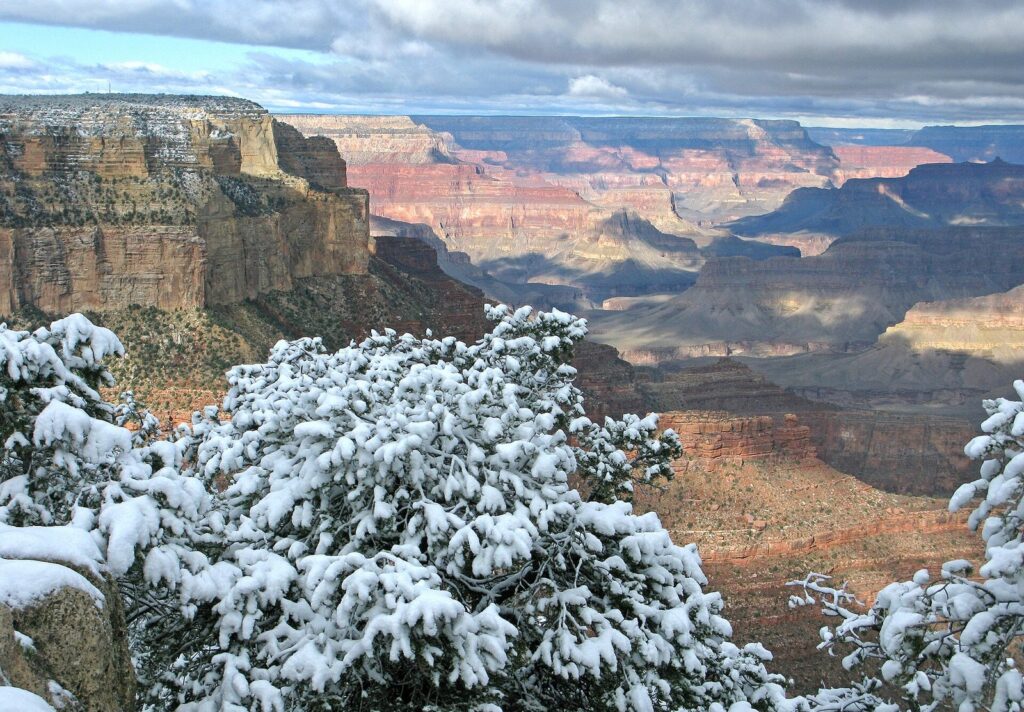
Plan the light, too. At Grand Canyon Village the sun rises around 5:10 a.m. and sets around 7:46 p.m. in mid-June, and rises around 7:38 a.m. and sets around 5:35 p.m. in mid-January. In winter, a day trip leaves you little daylight at the rim after a four-hour drive, which is another argument for staying the night.
How crowded does the Grand Canyon get?
Busy enough to plan around. The park draws more than 5 million visitors a year through three entrances, and most of them come to the South Rim. Spring break, summer and fall weekends are the busiest times, which is also when in-park lodging books up months ahead. The South Entrance can back up from mid-morning on busy days, so either arrive early, before about 9 a.m., come in through the quieter Desert View entrance on the east side, or arrive in the afternoon and stay for sunset. Once inside, the crowds concentrate at Mather Point and in the Village around midday; a short walk along the Rim Trail in either direction thins them out quickly.
Is the Grand Canyon a summer escape from Phoenix?
At the rim, very much so. The South Rim’s normal July high of 84.9°F is more than 20 degrees below Phoenix’s 106.5°F, and summer nights at the rim drop to around 50°F. That makes a summer overnight at the canyon one of the best heat breaks within driving distance of Phoenix. The catch is below the rim. The inner canyon is far hotter than the rim, often well over 100°F in summer, which is why the park warns day hikers off inner-canyon trails in the middle of the day. Enjoy the cool at the top, and if you hike down, do it at dawn and not far.
What does a Grand Canyon trip from Phoenix cost?
The park itself is inexpensive; the time and the lodging are where the money goes.
| Item (checked Sept 2026) | Cost | Notes |
|---|---|---|
| Park entrance, private vehicle | $35 | Valid 7 days; covers everyone in the car |
| Park entrance, motorcycle or individual | $30 or $20 | Individual applies to walkers, cyclists and some shuttle arrivals |
| Grand Canyon annual pass | $70 | Worth it only for repeat visits |
| Nonresident fee | $100 per person 16 and over | For non-U.S. residents, unless entering with an annual or America the Beautiful pass |
| South Rim shuttles | Free | Included with entry |
| Grand Canyon Railway | Varies by class | Round trip from Williams |
| Fuel | About 18-19 gallons | About 460 miles round trip at 25 mpg |
The nonresident fee is the number international visitors most often miss. A family of four adults from outside the United States pays $35 for the car plus $400 in nonresident fees at the South Rim, unless they arrive with an annual or America the Beautiful pass. If your group is visiting several big national parks on one trip, price the nonresident annual pass before you reach the gate; it can be the cheaper option.
Grand Canyon West or the South Rim?
Grand Canyon West is a different place, not a shortcut. It’s run by the Hualapai Tribe on its land at the canyon’s far western end, outside the national park, and it’s famous for the Skywalk, a glass-floored walkway that juts out over the canyon. It’s much closer to Las Vegas than to Phoenix: our routing puts it at 354 minutes, nearly six hours, and 250 miles from downtown Phoenix, against 257 minutes to the South Rim.
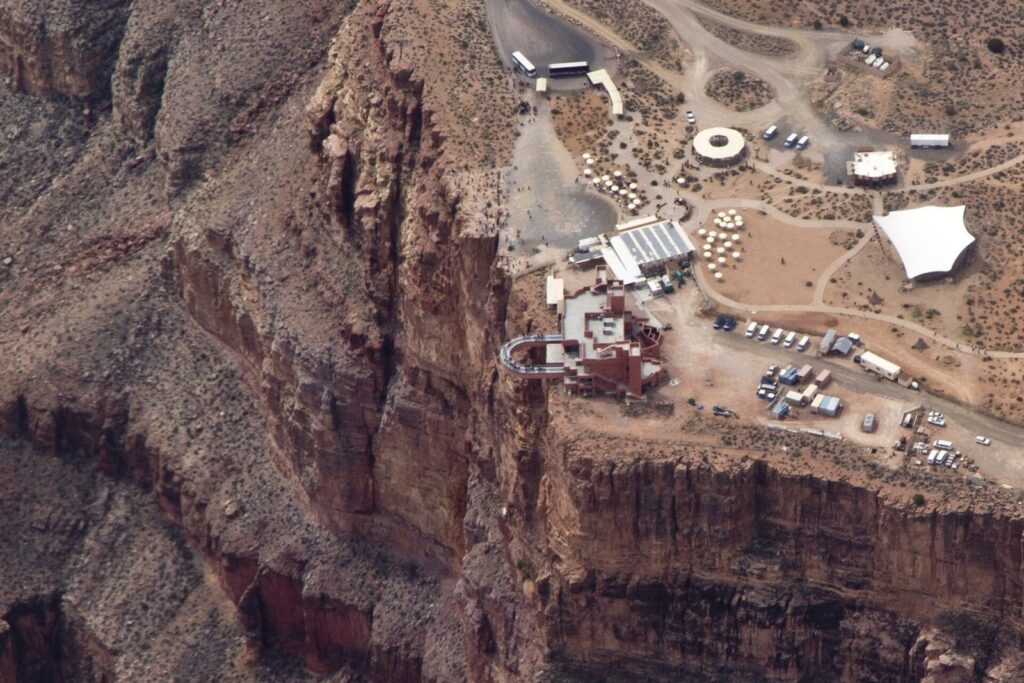
Tickets are sold by the tribe, not the Park Service. Its official site says the All-Access Pass is the ticket that includes the Skywalk, while General Admission doesn’t, and it lists an 8 a.m. opening with last entry around 4:30 p.m., later in summer (checked September 2026). Prices are set separately from national park fees and change through the year; 2026 listings put General Admission in the high $60s and the All-Access Pass near $100 before tax, so check before you go. Verdict: from Las Vegas, it’s a reasonable day. From Phoenix, the South Rim is closer, cheaper and, for most people, the better canyon.
What about the North Rim?
Not from Phoenix, and not this year. The North Rim sits across the canyon at a higher, colder elevation and is a much longer drive from Phoenix than the South Rim. It’s also recovering from the 2025 Dragon Bravo Fire, which destroyed the Grand Canyon Lodge, the visitor center and many cabins. In 2026 select areas reopened on May 15, the campground runs June 1 to October 15, there is no overnight lodging, and the gas station closed for the season on September 19 (checked September 2026). For a Phoenix-based trip, the South Rim is the Grand Canyon.
Can you combine the Grand Canyon with Sedona?
Yes, and it’s the best two-night loop from Phoenix. Drive to Sedona first, 135 minutes from downtown Phoenix, and spend the afternoon there; our guide to the drive from Phoenix to Sedona covers the route, the Red Rock Pass and the free trailhead shuttle. The next morning, drive north through Oak Creek Canyon to Flagstaff and on to the South Rim; Sedona to the Grand Canyon Visitor Center is 170 minutes and 117 miles. See sunset at the rim, stay the night, and drive home the fast way the next day. Trying to do Sedona and the Grand Canyon in a single day from Phoenix means more than nine hours of driving, which isn’t a trip so much as an endurance event.
If you’re weighing the canyon against shorter outings, our list of Phoenix day trips sorts the alternatives by how much time you have.
What should you pack for the Grand Canyon from Phoenix?
Pack for a different climate from the one you left. Even in July the rim’s normal low is about 50°F, and in January it’s about 19°F, so bring a warm layer and a hat for sunrise and sunset whatever the season. Carry refillable water bottles; the thin, dry air at 6,882 feet dehydrates you faster than you’d expect, and the sun is strong at altitude, so sunscreen and sunglasses matter as much as in Phoenix. Wear shoes with grip for the Rim Trail and any walk below the rim, bring a headlamp or flashlight if you plan to be out for sunrise, and in winter add traction devices for icy paths. On a day trip, pack lunch and snacks to save time in the Village’s lines.
Can you get to the Grand Canyon from Phoenix without a car?
Yes, but your choices narrow to organized ones. A guided tour from Phoenix or Scottsdale is the simplest option, with hotel pickup and a driver for the long highway miles. The Grand Canyon Railway is the other car-free way into the park, but it starts in Williams, three hours from Phoenix, so you still need a way to get there. Once you’re at the South Rim, the free shuttles cover the Village, the Visitor Center, Hermit Road and the Kaibab Rim, so a car isn’t needed inside the park itself. What you give up without a car is flexibility: Desert View, sunrise at the viewpoint of your choice and the freedom to stay until the light is perfect.
What to skip
- Skip the Grand Canyon as a day trip if you can spare a night. The drive is 257 minutes each way before stops; one night buys you sunset, sunrise and a relaxed morning for the same miles.
- Skip Grand Canyon West from Phoenix. It’s nearly six hours each way, outside the national park, with separate tickets. The South Rim is closer and, for most people, better.
- Skip driving between viewpoints on a busy day. Park once and use the free shuttles; they run every 12 to 15 minutes on the Village route through the day in fall 2026.
- Skip hiking below the rim at midday in hot weather. The park warns hikers away from the inner canyon between 10 a.m. and 4 p.m., and the climb back up always takes longer than you think.
- Skip the North Rim this year. Its lodge burned in 2025, there’s no overnight lodging in 2026, and it’s much farther from Phoenix.
- Skip the drive home in the dark after a long day. Four hours on I-40 and I-17 at night, with elk and deer about, is the riskiest part of the trip. Stay the night, or leave the rim by mid-afternoon.
- Skip assuming it’s warm because Phoenix is. The rim is at 6,882 feet, with January lows around 19°F and about 43 inches of snow a year.
Frequently Asked Questions
How far is the Grand Canyon from Phoenix?
The South Rim is about 229 to 231 miles from downtown Phoenix. The fastest route to the Grand Canyon Visitor Center took 257 minutes off-peak in our September 2026 routing, via I-17 and either I-40 through Williams or US 180 through Flagstaff. With a stop and a line at the entrance, plan on about four and a half hours each way.
Can you do the Grand Canyon in a day from Phoenix?
Yes, but it’s a very long day: about eight and a half hours of driving for three to five hours at the rim, usually without sunset or sunrise. A coach tour of 13 to 15 hours spares you the driving. If you can, stay one night in the park, Tusayan, Williams or Flagstaff instead.
How much does it cost to enter the Grand Canyon?
$35 per private vehicle, valid for 7 days and covering everyone in the car; $30 per motorcycle; and $20 per individual (checked September 2026). A Grand Canyon annual pass costs $70. Non-U.S. residents 16 and older also pay a $100 per-person nonresident fee unless they enter with an annual or America the Beautiful pass.
Is the Grand Canyon Railway worth it from Phoenix?
As part of an overnight, yes. The train leaves Williams at 9:30 a.m. (8:30 in November and December) and returns at 5:45 p.m. (4:45), with more than three hours at the canyon (checked September 2026). Williams is about three hours from Phoenix, so a same-day train trip means a very early start and a late return.
Which Grand Canyon rim is closest to Phoenix?
The South Rim, about 257 minutes from downtown Phoenix by the fastest route. Grand Canyon West, run by the Hualapai Tribe and home to the Skywalk, is nearly six hours away and much closer to Las Vegas. The North Rim is farther still, and in 2026 it has no overnight lodging after the 2025 Dragon Bravo Fire.
Where should you stay near the Grand Canyon?
Inside the park if you can book it: El Tovar, Bright Angel, Kachina, Thunderbird, Maswik or Yavapai Lodge, which put sunset within walking distance; they book up far ahead for spring and summer. Tusayan, just outside the South Entrance, is the nearest fallback. Williams suits a train trip, and Flagstaff has the most choice for a trip that includes Sedona.
Does the Grand Canyon get snow?
The South Rim does. At 6,882 feet, Grand Canyon Village averages about 43 inches of snow a year, mostly from December through March, and its normal January low is 19.2°F. Rim paths can be icy, and storms can slow I-40 and I-17. Check the forecast before driving up from Phoenix in winter, and pack warm layers.
What is the best time of day to see the Grand Canyon?
Sunrise and sunset. Low sun brings out the reds and golds of the canyon walls and throws long shadows that show its depth, while midday light flattens the view into haze. At Grand Canyon Village the sun sets around 7:46 p.m. in mid-June and 5:15 p.m. in mid-December, so staying one night near the rim is the easiest way to see both ends of the day.
Related Phoenix Guides
- Sedona Day Trip From Phoenix: the drive, the Red Rock Pass, the free trailhead shuttle and a one-day plan.
- The Best Day Trips From Phoenix: shorter trips sorted by the time you have, with drive times both ways.
Sources and verification
This guide is built from research, not hosted trips. Fees, shuttle schedules, train times, lodging and closures were checked on September 24, 2026, against the agencies and operators below. Drive times are off-peak estimates from OSRM routing on OpenStreetMap data; sunrise and sunset times are computed for Grand Canyon Village; climate figures are NOAA’s 1991-2020 normals.
- National Park Service, Grand Canyon: fees and passes; South Rim shuttle routes, fall 2026; lodging; directions to the South Rim; North Rim status; Hike Smart
- Grand Canyon Railway: schedule and classes
- Grand Canyon West (Hualapai Tribe): tickets; hours and FAQs
- NOAA: 1991-2020 normals, Grand Canyon; Phoenix
- U.S. Geological Survey: Elevation Point Query Service
Photo Credits
- El Tovar Hotel: photo by This Photo was taken by Wolfgang Moroder. Feel free to use my photos, but please mention me as the author and send me a message. This image is not in the public domain. Please respect the copyright protection. It may only be used according to the rules mentioned here. This specifically excludes use in social media, if applicable terms of the licenses listed here not appropriate. Please do not upload an updated image here without consultation with the Author. The author would like to make corrections only at his own source. This ensures that the changes are preserved.Please if you think that any changes should be required, please inform the author.Otherwise you can upload a new image with a new name. Please use one of the templates derivative or extract., Wikimedia Commons (CC BY-SA 3.0)
- Grand Canyon Railway depot, Williams: photo by NearEMPTiness, Wikimedia Commons (CC BY-SA 4.0)
- Desert View Watchtower: photo by DXR, Wikimedia Commons (CC BY-SA 4.0)
- Grand Canyon shuttle bus: photo by Grand Canyon National Park, Wikimedia Commons (CC BY 2.0)
- Early snow on the South Rim: photo by Grand Canyon National Park, Wikimedia Commons (CC BY 2.0)
- Grand Canyon Skywalk: photo by [email protected] (Werner Keulen, labete), Wikimedia Commons (CC BY-SA 3.0)
- Mather Point, Grand Canyon (featured image): photo by Tuxyso, Wikimedia Commons (CC BY-SA 3.0)