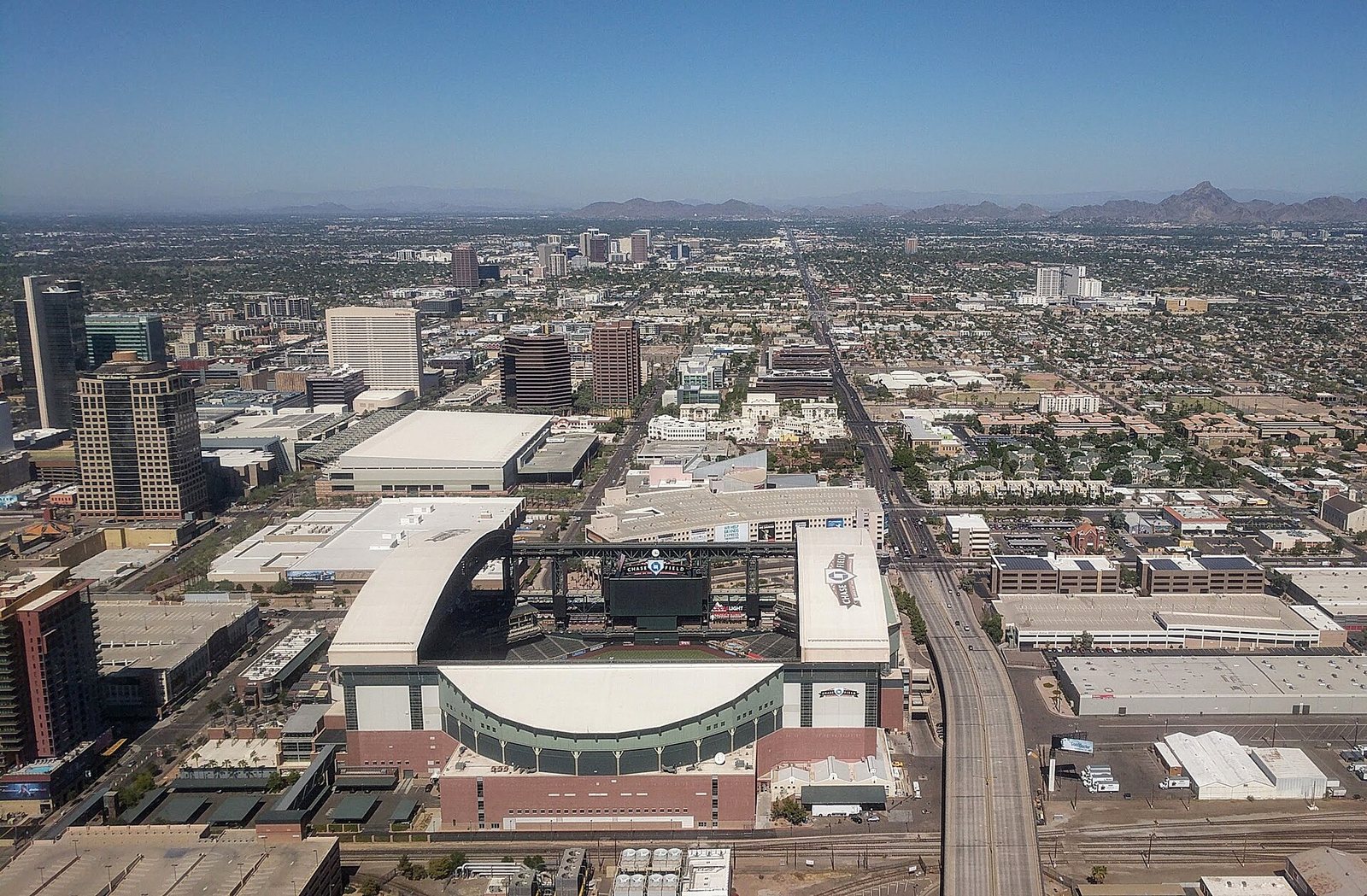
Arizona has four major-league teams, and a surprising amount of travel content still lists five. The Coyotes left in April 2024, when the NHL created a new franchise in Utah that is now the Utah Mammoth, so Arizona has had no NHL team since. The Suns’ arena changed its name again in October 2025 and is now Mortgage Matchup Center. Getting those basics right is where any guide to Phoenix sports teams has to start. After that, the questions a visitor actually has are simpler: who’s playing while I’m in town, how do I get there, and which game is worth the money?
Short answer: Phoenix has four major-league teams: the Diamondbacks (MLB) at Chase Field downtown from late March to September, the Suns (NBA) at Mortgage Matchup Center downtown from October to April, the Mercury (WNBA) at the same arena from May to September, and the Cardinals (NFL) at State Farm Stadium in Glendale from September into January. The easiest game for a visitor is a Diamondbacks or Suns game downtown, reached by light rail for $2 a ride (2026 fare).
Schedules, venues and transit details in this guide were last checked on September 24, 2026. Game dates and kickoff times can change; confirm on the team’s own schedule before you buy.
Phoenix sports teams at a glance
| Team | League | Venue; drive from downtown | Season | Getting there (checked Sept 2026) |
|---|---|---|---|---|
| Arizona Diamondbacks | MLB | Chase Field, downtown Phoenix; 2-3 min | Late March to September | Light rail; roof and air conditioning |
| Phoenix Suns | NBA | Mortgage Matchup Center, downtown Phoenix | October to April; home opener Oct. 24, 2026 | Light rail; 700+ arena parking spaces |
| Phoenix Mercury | WNBA | Mortgage Matchup Center, downtown Phoenix | May to September | Light rail |
| Arizona Cardinals | NFL | State Farm Stadium, Glendale; 24-25 min | September into January | Car or rideshare; no light rail |
| Arizona State football | NCAA, Big 12 | Mountain America Stadium, Tempe; about 18 min | September to November | Light rail |
| Arizona State hockey and basketball | NCAA | Mullett Arena and Desert Financial Arena, Tempe | October to March | Light rail |
| Grand Canyon University basketball | NCAA | Global Credit Union Arena, west Phoenix | November to March | Car or rideshare |
| Phoenix Rising FC | USL Championship | Phoenix Rising Soccer Stadium, east Phoenix near Sky Harbor | Spring to fall | Car or rideshare |
| Arizona Rattlers | Indoor Football League | Desert Diamond Arena, Glendale | Spring and summer | Car or rideshare |
| No NHL team | NHL | The Coyotes left for Utah in 2024 | None | Not applicable |
Spring training, the WM Phoenix Open, NASCAR at Phoenix Raceway and NBA All-Star Weekend all draw big crowds too, but they are events rather than home teams. Our guide to Cactus League spring training covers the 10 ballparks and the February-to-March season, and the Phoenix events calendar covers the rest.
Which Phoenix sports teams are playing when you visit?
The Valley’s sports calendar is unusually full because its seasons overlap and its weather keeps one big venue or another in play all year. Here is what’s on, season by season.
| Months | In season (checked Sept 2026) | Best bet for a visitor |
|---|---|---|
| January-March | Suns; Cardinals into January; ASU and GCU basketball; ASU hockey; spring training from Feb. 19, 2027 | A Suns game, or spring training |
| April-May | Diamondbacks; Suns into the playoffs; Mercury from May; Phoenix Rising | An early-season Diamondbacks game |
| June-August | Diamondbacks; Mercury; Phoenix Rising; Arizona Rattlers | Diamondbacks under Chase Field’s roof |
| September-October | Diamondbacks through September; Cardinals; ASU football; Mercury playoffs; Suns from late October | An ASU night game or a Cardinals home game |
| November-December | Suns; Cardinals; ASU football into November; college basketball; the Fiesta Bowl at the turn of the year | A Suns game downtown |
For exact dates, go to the source: the Cardinals’ 2026 schedule release, Arizona State’s home football dates and the teams’ own ticketing pages are updated as television moves games around.
Summer is the surprise. Outdoor sport in Phoenix is brutal from June to September, but the two downtown venues are air-conditioned, so the Diamondbacks and the Mercury make summer the one season when a ballgame is also the most comfortable place in town. Winter is the Suns’ season, and fall is football’s, with the Cardinals in Glendale and Arizona State in Tempe.
Where are Phoenix’s stadiums and arenas?
The Valley’s venues fall into four clusters, and knowing which cluster a game is in tells you most of what you need about getting there.
Downtown Phoenix. Chase Field and Mortgage Matchup Center stand a few blocks apart, next to the convention center, the downtown hotels and the light rail. Both are within minutes of Sky Harbor. If you’re staying downtown, you can walk to either.
Tempe. Arizona State’s Mountain America Stadium, Desert Financial Arena and Mullett Arena sit on and around the campus by Tempe Town Lake, 17 to 18 minutes from downtown Phoenix and also on the light rail. Mill Avenue’s bars and restaurants are the pre-game street.
Glendale’s Westgate district. State Farm Stadium and Desert Diamond Arena share a campus with Westgate’s restaurants on the West Valley side, about 24 minutes from downtown Phoenix, 34 from Tempe’s Mill Avenue and 38 from Old Town Scottsdale off-peak (checked September 2026). No light rail reaches it.
Elsewhere. Phoenix Rising’s stadium is in east Phoenix near Sky Harbor, and Grand Canyon University’s arena is on its campus in west Phoenix. Both are short drives from downtown but off the rail line.
How did Phoenix become a four-team town?
Slowly, and then quickly. The Suns arrived first, in 1968, and for two decades they were the only major-league team in Arizona. The Cardinals moved from St. Louis in 1988, and the 1990s brought a rush: the Coyotes in 1996, the Mercury as one of the WNBA’s original teams in 1997 and the Diamondbacks as an expansion club in 1998. Three years later the Diamondbacks beat the New York Yankees in a seven-game World Series, still the Valley’s only major men’s championship, and they reached the World Series again in 2023.
The Mercury have been the Valley’s most successful team, with three WNBA titles, in 2007, 2009 and 2014. The Suns have reached the NBA Finals three times, most recently in 2021, and the Cardinals played in Super Bowl XLIII after the 2008 season. The Coyotes’ story ended differently: after years of arena trouble, their final two seasons were played at a 5,000-seat college rink in Tempe, and in 2024 the team’s hockey operations went to Utah. That history explains why some visitors still expect five teams, and why the local answer is four.
Arizona Diamondbacks at Chase Field
Downtown Phoenix. Two to three minutes from the center, or a light-rail ride. Chase Field opened in 1998 and was built for Phoenix’s weather: a retractable roof that opens or closes in just over four minutes, and air conditioning that makes a July night game genuinely pleasant. With the roof closed in summer, it’s one of the coolest places in the city. Beyond the outfield wall there’s a small swimming pool that is rented as a suite, the ballpark’s best-known quirk, and the concourses are full of local food.
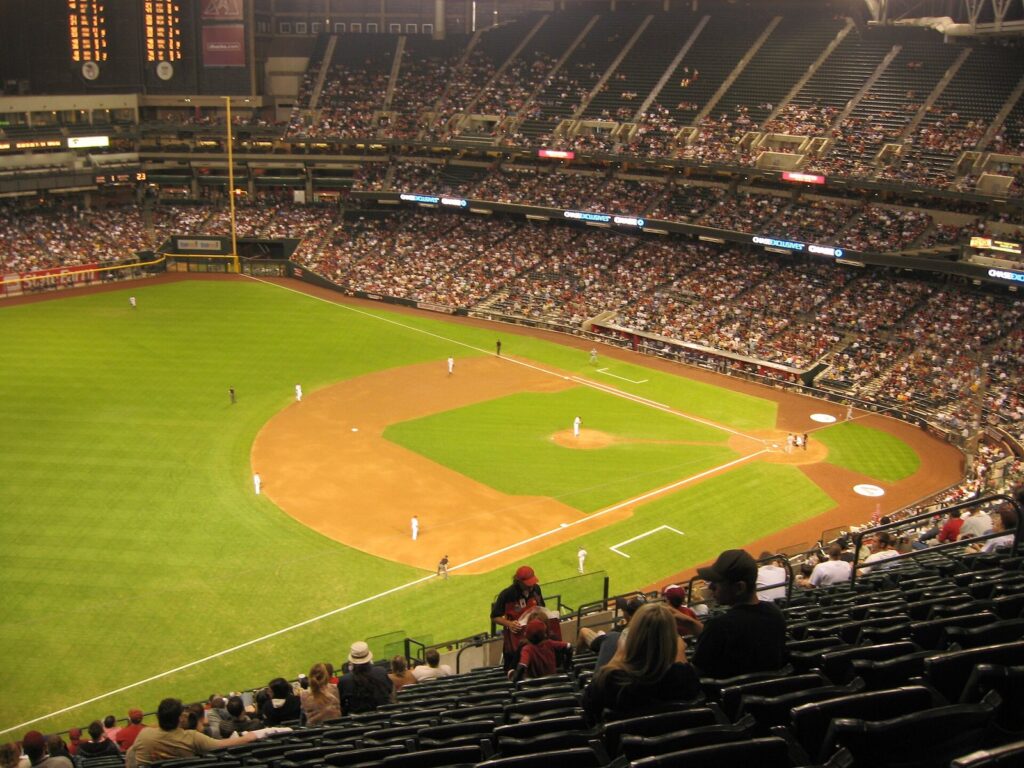
The regular season runs from late March to late September. For 2027, Major League Baseball’s schedule starts the Diamondbacks on the road, with their home opener expected in early April; check the team’s schedule before you plan around it. Tickets are priced by opponent, day and demand, so a midweek game against a non-rival is usually among the cheapest big-league seats in the Valley, while weekend games against the Dodgers or Giants cost more and fill faster.
Getting there is easy. The light rail stops within a short walk, and the free Sky Train connects Sky Harbor’s terminals to it at the 44th Street station, so you can reach a game from the airport without a car. If you drive, downtown garages and lots charge event rates that vary by game; take the train and the cost is $2 each way, capped at $4 a day with tap-to-pay (checked September 2026). Verdict: the best game in town for a summer visitor and a very good one in spring.
Phoenix Suns and Phoenix Mercury at Mortgage Matchup Center
201 E. Jefferson St., downtown Phoenix, a few blocks from Chase Field. The arena has had more names than most: it opened as America West Arena and has since been US Airways Center, Talking Stick Resort Arena, Footprint Center from 2021 to 2025 and, briefly, PHX Arena, before it was renamed Mortgage Matchup Center on October 2, 2025, under a 10-year naming deal worth nearly $115 million. If a ticket, map or guide still calls it Footprint Center, it’s out of date; the building is the same.
The Suns play from October to April. Their 2026-27 home opener is October 24 against the Golden State Warriors, according to the schedule released in August 2026. The Mercury, one of the WNBA’s founding teams, play from May into September, and their games are one of the best-value nights out downtown in summer. The arena will also host NBA All-Star Weekend on February 19-21, 2027, which will make that week’s hotels and tickets scarce.
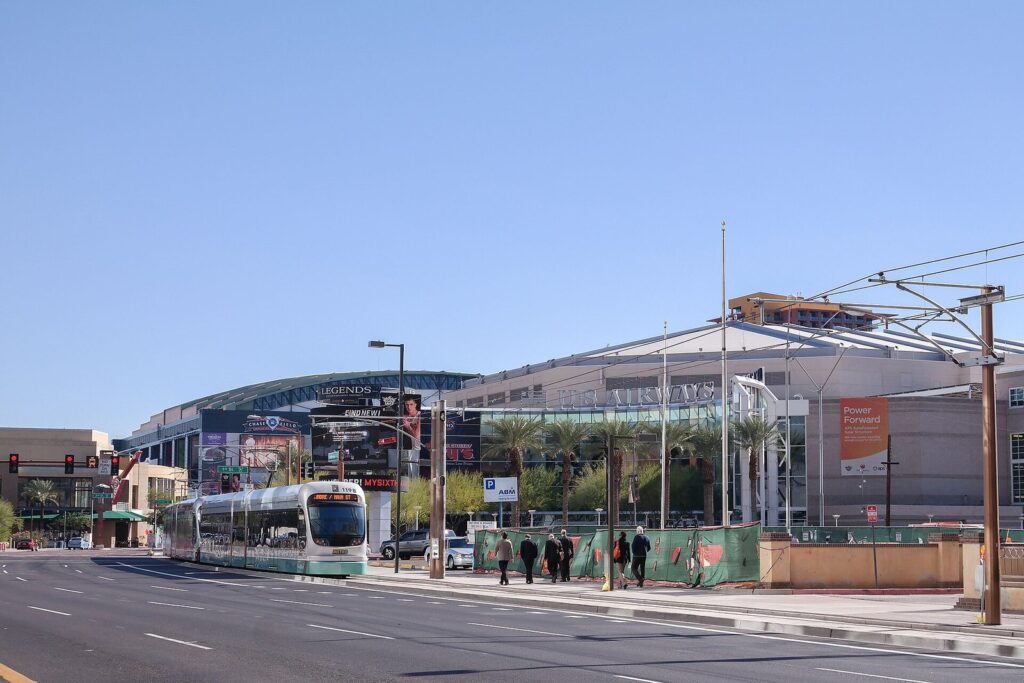
Game-day logistics are simple. The arena has more than 700 on-site parking spaces, including accessible spaces, with rates that vary by event and can be bought ahead online; downtown garages add many more. The light rail stops a short walk away. The arena’s bag policy is strict, and guests without bags, or with only a clutch smaller than 4 by 6 inches, can use the faster express entry lanes (checked September 2026). Arrive early, eat downtown beforehand and walk over. Verdict: a Suns game is the Valley’s best winter sports night, and a Mercury game is its best summer bargain.
Don’t treat the Mercury as a consolation prize. They are the Valley’s most decorated team, with three WNBA championships, and their crowds are loud, family-heavy and loyal. Games move quickly, tickets are usually easier to get than for the Suns, and the season falls exactly when a visitor most needs an air-conditioned evening plan. If you’re in Phoenix between May and September and like basketball at all, a Mercury game is one of the best-value nights out in the city.
Spring training or a regular-season game?
If you’re visiting between mid-February and late March, you’ll have to choose, and the two are very different outings. Spring training puts 15 teams in 10 small ballparks around the Valley, with cheaper tickets, lawn seating, players close enough to talk to and games that don’t count. A regular-season Diamondbacks game at Chase Field is big-league baseball with stakes, under a roof, in a 1998 downtown stadium. For a relaxed afternoon in the sun, pick spring training; for a real game, wait for April. The two seasons barely overlap: the 2027 Cactus League schedule ends on March 23, and the Diamondbacks open the regular season a couple of days later.
Arizona Cardinals at State Farm Stadium
1 Cardinals Drive, Glendale. About 24-25 minutes west of downtown Phoenix off-peak. The Cardinals’ stadium has a retractable roof and a natural-grass field that rolls outside on a giant tray to get sunlight between games, which is why the turf stays green in the desert. It has hosted three Super Bowls, most recently in 2023, and the Fiesta Bowl, a College Football Playoff game in the 2026-27 season, is played here at the end of December. Next door, Westgate’s restaurants and bars make the pre-game area walkable once you’ve parked.
The NFL season runs from September into January. For 2026, the Cardinals opened on the road and played their home opener against Seattle on September 20. The remaining home games on the released schedule are Detroit on October 11, Denver on October 25, the Los Angeles Rams on November 15 and Washington on November 29, with the season closing at home against the Raiders and the 49ers; the team plays six of its last eight games in Glendale. Kickoff times can move for television, so confirm the week before (schedule as released, checked September 2026).
Plan the trip, because this is the one major venue the light rail doesn’t reach. Most fans drive or take a rideshare, and post-game traffic out of Glendale is slow; give yourself time, or stay for dinner at Westgate and let the lots empty. Verdict: worth it for football fans in the cool months, but the most logistically demanding game in the Valley. Budget for parking and traffic as well as the ticket.
What about tailgating?
Tailgating is part of both the Cardinals’ and Arizona State’s game days, in the lots around State Farm Stadium and on and around the ASU campus. Rules on grills, tents and alcohol differ by lot and by venue, and they change, so read the team’s game-day guide before you pack a cooler. In September, the heat is the main hazard: an early-afternoon tailgate in a Glendale parking lot can run past 100°F, so bring shade, more water than beer and a plan to be inside the stadium before you wilt. By November, a Valley tailgate is one of the pleasures of the season.
College sports: Arizona State and Grand Canyon University
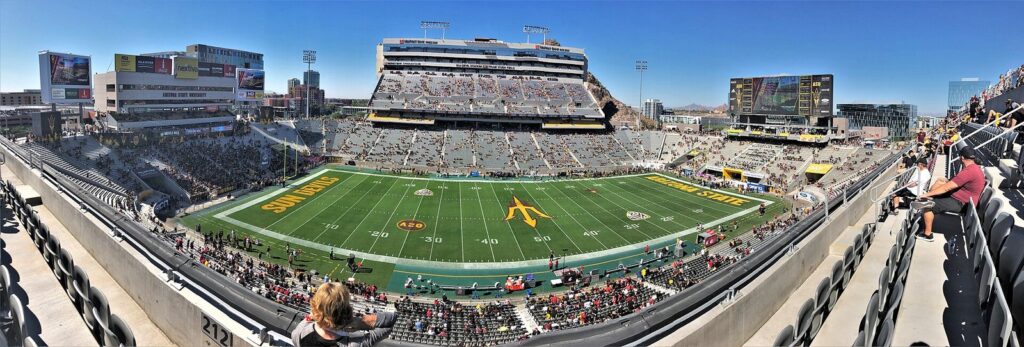
Arizona State football. The Sun Devils play in the Big 12 at Mountain America Stadium, 500 E. Veterans Way, Tempe, set between the two buttes beside Tempe Town Lake. It’s about 18 minutes from downtown Phoenix and right on the light rail. In 2026, ASU’s remaining home games after mid-October were Kansas State on October 24, Colorado on November 7 and Oklahoma State on November 21, which is Homecoming (dates as announced by ASU; times depend on TV and the conference’s Friday selections, checked September 2026). Early-season games often kick off at night because of the heat; a late-season night game in Tempe, with the students in and the air finally cool, is one of the best atmospheres in Arizona sport.
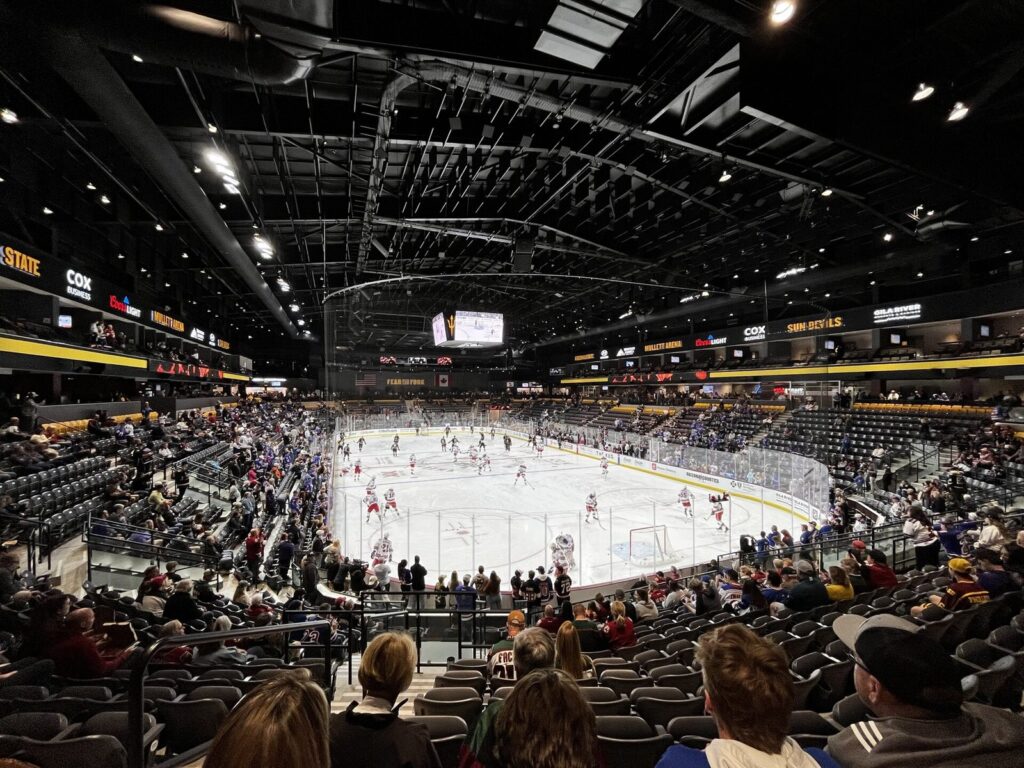
Arizona State basketball and hockey. The men’s and women’s basketball teams play at Desert Financial Arena on the Tempe campus, and ASU hockey plays at Mullett Arena, a compact, loud rink that opened in 2022 and was also the Coyotes’ temporary home for their last two NHL seasons before the team’s hockey operations went to Utah in 2024. A college hockey game there is a lively, affordable night out.
Grand Canyon University basketball. GCU plays at Global Credit Union Arena on its west Phoenix campus, where the student section has a reputation as one of the loudest in college basketball. If you like college hoops, it’s worth a look from November to March.
College basketball is the Valley’s most underrated winter ticket. Tickets for Arizona State and GCU games usually cost far less than an NBA game, the arenas are smaller and noisier, and the schedules overlap with the Suns’, so on a winter trip you can often fit in both. Check the schools’ athletics sites for home dates, since conference games cluster from January to early March and holiday tournaments fill December.
Soccer, arena football and the rest
Phoenix Rising FC plays in the USL Championship, the level below Major League Soccer, at Phoenix Rising Soccer Stadium on East Washington Street, near Sky Harbor. The stadium seats about 10,000 and opened in 2023, and its intimate size makes it a good family outing on a warm-season evening.
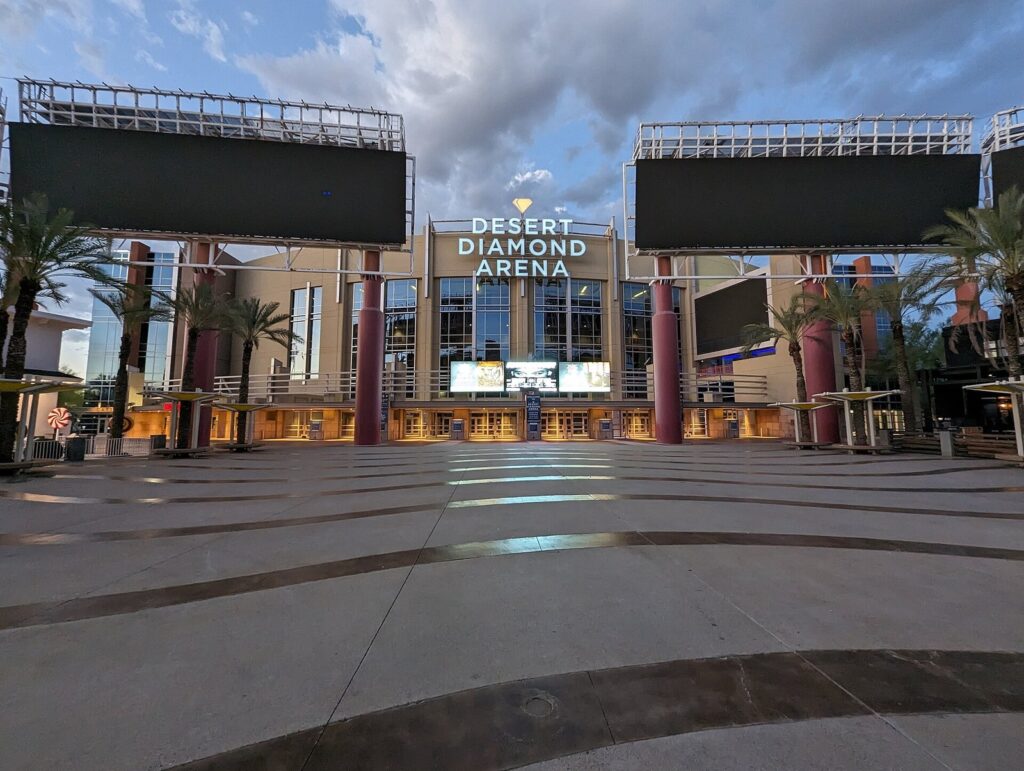
The Arizona Rattlers play indoor football in the Indoor Football League at Desert Diamond Arena in Glendale, next to State Farm Stadium, with a spring and summer season; the team was signing players for 2027 in September 2026. It’s fast, high-scoring and cheap, and the arena’s air conditioning is welcome by June.
The Valley’s big sporting events sit in other guides. NASCAR races at Phoenix Raceway in Avondale, the WM Phoenix Open is golf’s rowdiest tournament at TPC Scottsdale in February, and spring training fills 10 ballparks from February 19 to March 23, 2027. Those are once-a-year events rather than teams you can catch on any week of your trip.
Which venues are air-conditioned, and which are open to the sky?
In Phoenix this is a real planning question, because an open-air seat in the afternoon sun from May to September can be miserable, and even the walk from the parking lot matters. Here’s how each venue handles the heat.
| Venue | Roof | Heat plan |
|---|---|---|
| Chase Field (Diamondbacks) | Retractable, air-conditioned | Roof closed on hot days; comfortable all summer |
| Mortgage Matchup Center (Suns, Mercury) | Indoor arena | Comfortable year-round; the heat is only on the walk in |
| State Farm Stadium (Cardinals) | Retractable | Roof usually closed in hot weather; the parking lots are the hot part in September |
| Mountain America Stadium (ASU football) | Open-air | Early-season games kick off at night; bring water and a light layer for late fall |
| Mullett Arena and Desert Financial Arena (ASU) | Indoor | Comfortable year-round |
| Desert Diamond Arena (Rattlers) | Indoor | Comfortable year-round |
| Phoenix Rising Soccer Stadium | Open-air | Choose evening games in the warm months |
The outdoor waits are the thing to plan for. Security lines, walks from distant lots and early-season tailgates happen in full sun, so on a hot day carry water, wear a hat and arrive with enough time that you aren’t standing in a line at the hottest hour. At Mountain America Stadium, the first home games of the season are still warm at kickoff even at night; by November, you’ll want a jacket by the fourth quarter.
How do you get to Phoenix games without a car?
For the downtown and Tempe venues, easily. Valley Metro’s light rail runs past Chase Field and Mortgage Matchup Center downtown and through Tempe near Arizona State’s stadium and arenas, and the free PHX Sky Train links it to Sky Harbor. A ride costs $2 and tap-to-pay caps your spending at $4 a day (checked September 2026), which beats almost any event parking. Trains run until around midnight, but check the last train before a late game, especially one that might go to overtime or extra innings.
Waymo’s driverless cars cover downtown Phoenix, Scottsdale and parts of Tempe, Mesa and Chandler, and conventional rideshare works everywhere, though post-game surge pricing and pickup lines can be long. For State Farm Stadium, Desert Diamond Arena, Global Credit Union Arena and Phoenix Rising’s stadium, you’ll need a car or a rideshare; plan your pickup spot before the game and expect to wait after it.
What does a game day in Phoenix cost?
Ticket prices in the Valley, as everywhere, float with demand, so there’s no single price to quote. What moves them is predictable: the opponent, the day of the week, the standings and giveaways or promotions. A midweek Diamondbacks game against a non-rival or a Mercury game in summer costs the least; a Suns game against a marquee opponent, a Cardinals game against a division rival or anything close to the playoffs costs the most. Buy from the team’s official ticketing partner or its verified resale, and compare a few dates if you’re flexible.
| Game-day cost (checked Sept 2026) | What to expect |
|---|---|
| Light rail to downtown or Tempe venues | $2 a ride; tap-to-pay caps at $4 a day |
| Parking at Mortgage Matchup Center | Varies by event; 700+ on-site spaces; buy ahead online |
| Downtown garages for Chase Field | Event rates that vary by game |
| State Farm Stadium | Paid lots; the biggest parking and traffic plan of any venue |
| Tickets | Dynamic; cheapest midweek, against non-rivals, early in the season |
The arithmetic favors the train for downtown games: two people riding light rail both ways pay $8 at most, and often less with the daily cap. For a family, a summer Diamondbacks or Mercury game plus the train is the cheapest big-league outing in the Valley.
What does a game day look like, start to finish?
Here’s a typical Suns night for a visitor staying downtown, which works almost the same for a Diamondbacks or Mercury game. Check the event page for the exact start and gate times, which vary by game.
Late afternoon. Buy or load your digital tickets, check the bag policy and decide whether you’ll bring a bag at all; going bag-free gets you into the faster entry lanes at the arena. If you’re driving in, buy parking ahead.
Early evening. Eat downtown before the game. The blocks around the arena and Chase Field fill up with fans two hours or so before tip-off or first pitch, so book a table or go early. If you’re coming from Tempe or near the airport, the light rail drops you a short walk from both venues.
Game time. Get to your seat before the start; entry lines grow in the last half-hour. At Chase Field, walk the concourse during the middle innings, when the lines for food and drinks are shortest.
After the game. The trains are busy for the first few minutes after a big game, then thin out, so a drink or dessert downtown is a better plan than joining the rush. Check the last train if the game runs late.
How do you buy tickets without overpaying?
Start with the team. Every club in the Valley sells through its own website and an official ticketing partner, and most tickets are now digital, delivered to your phone. Official resale marketplaces linked from the team sites let season-ticket holders sell seats safely, which is where many of the best prices appear for low-demand games.
Timing matters. For a big game, such as a marquee NBA opponent, a division rival in the NFL or any late-season game with playoff stakes, prices climb as the date approaches, so buy early. For an ordinary midweek baseball game or an early-season college game, prices on resale sites often fall close to game day as sellers try to recover something for seats they can’t use. Compare a couple of dates if your schedule allows it; the difference between a Tuesday and a Saturday can be large.
Avoid the street. Buying from someone outside the venue is the easiest way to end up with a fake or a transferred-twice ticket, and digital tickets make that risk higher, not lower. If a price elsewhere looks too good to be true, check it against the team’s own site first.
Which big games are worth planning a trip around?
Some dates are worth building a Phoenix trip around, and they fill hotels as well as stadiums.
NBA All-Star Weekend, February 19-21, 2027. The league’s showcase comes to Mortgage Matchup Center, with the Rising Stars game on Friday, the Saturday night events and the All-Star Game on Sunday. Tickets are expensive and scarce, and the week also overlaps the first games of spring training and falls just after the WM Phoenix Open, so downtown hotels will be at a premium.
The Fiesta Bowl, December 30, 2026. A College Football Playoff game at State Farm Stadium in Glendale, played in the cool of the Valley’s winter, with a parade and fan events around it.
Rivalry and late-season games. The Cardinals close their 2026 season at home against the Raiders and the 49ers, and a late-season NFL game with playoff stakes is the best atmosphere in Glendale. In Tempe, Arizona State’s Homecoming game against Oklahoma State on November 21 draws alumni and a full stadium.
Opening weeks. The Suns’ home opener on October 24, 2026, and the Diamondbacks’ first home series in early April both have a buzz that a random midseason game doesn’t, and they arrive when the Valley’s weather is at its best.
Where should you stay for a game?
Match your hotel to the venue. For the Diamondbacks, Suns and Mercury, stay downtown: the convention hotels around the Phoenix Convention Center are a short walk from both venues, and you can skip the car entirely. For Arizona State games and ASU Gammage shows, Tempe’s Mill Avenue hotels put you on the light rail and near the stadium. For a Cardinals game or a Rattlers game, Westgate’s hotels in Glendale save you the post-game drive, and the district’s restaurants and bars give you something to do while the lots empty. If your trip includes spring training too, choose a central base and drive to each park.
Are Phoenix games good for kids and accessible for everyone?
For kids, the downtown venues are the easiest: air-conditioned, reachable by train and short enough that a family can leave early without losing much. A Diamondbacks game, with room to wander the concourse, suits younger children best; a Mercury or Rattlers game is quick, loud and affordable. Bring ear protection for small children at the arena and indoor-football games, which are very loud.
For accessibility, the major venues have accessible seating and entrances, and Mortgage Matchup Center includes designated accessible parking among its 700-plus on-site spaces. The light rail and its stations are step-free, which makes the downtown and Tempe venues the simplest to reach without a car. Book accessible seats directly with the team, where you can confirm companion seating and the nearest entrance.
Which game should a visitor choose?
In summer: the Diamondbacks, under Chase Field’s roof, or the Mercury next door. Both are downtown, air-conditioned and on the light rail.
In winter: the Suns. A night game downtown with dinner beforehand is the Valley’s classic cool-season sports evening.
In fall: football. Choose a Cardinals game if you’re a pro-football fan and have a car and a plan for traffic; choose an Arizona State night game if you want the atmosphere and the light rail.
In spring: spring training first, then the Diamondbacks’ opening weeks. April is the one month when Chase Field’s roof is often open on a pleasant evening, the walk from the train is comfortable and the season still feels new, which makes an early-season home game the most relaxed big-league night of the year.
On a budget: a midweek Diamondbacks game, a Mercury game, Phoenix Rising or the Rattlers, or college hockey at Mullett Arena.
What to skip
- Skip looking for NHL hockey. The Coyotes left in 2024 when the NHL created a franchise in Utah, now the Utah Mammoth, and Arizona has no NHL team. For hockey, see ASU at Mullett Arena.
- Skip trusting guides that say Footprint Center. The arena was renamed Mortgage Matchup Center in October 2025; use the new name for tickets, maps and rideshare pickups.
- Skip driving downtown for a Suns or Diamondbacks game. The light rail costs $2 a ride and drops you nearby; event parking costs far more and the post-game exit is slow.
- Skip a Cardinals game without a traffic plan. State Farm Stadium isn’t on the light rail, and the lots empty slowly. Arrive early, and stay for dinner at Westgate after.
- Skip buying tickets from street sellers outside the venue. Use the team’s official ticketing or verified resale.
- Skip an outdoor game in the heat of a summer afternoon. Stick to the air-conditioned venues from June to September, or go in the evening.
Frequently Asked Questions
How many professional sports teams does Phoenix have?
Four major-league teams: the Arizona Diamondbacks (MLB), Phoenix Suns (NBA), Phoenix Mercury (WNBA) and Arizona Cardinals (NFL). The Valley also has Phoenix Rising FC in the USL Championship and the Arizona Rattlers in the Indoor Football League, plus Arizona State and Grand Canyon University in college sport. There has been no NHL team since the Coyotes left in 2024.
Does Phoenix have an NHL team?
No. The Arizona Coyotes’ hockey operations went to Utah in April 2024, when the NHL created a new franchise there, and the team has been the Utah Mammoth since May 2025. For hockey in the Valley, Arizona State plays at Mullett Arena in Tempe, the rink that was also the Coyotes’ temporary home in their last two seasons.
Where do the Phoenix Suns play?
At Mortgage Matchup Center, 201 E. Jefferson St. in downtown Phoenix, the arena formerly called Footprint Center, which was renamed on October 2, 2025. The Phoenix Mercury play there too. The light rail stops a short walk away, and the arena has more than 700 on-site parking spaces with event-based rates.
Is Chase Field air-conditioned?
Yes. Chase Field, home of the Arizona Diamondbacks in downtown Phoenix, has a retractable roof that opens or closes in just over four minutes and full air conditioning, so summer games are played in comfort with the roof closed. That makes a Diamondbacks game one of the best things to do in Phoenix on a hot evening from June to September.
How far is State Farm Stadium from downtown Phoenix?
About 24 to 25 minutes west by car off-peak, in Glendale (checked September 2026). The stadium isn’t on the light rail, so most fans drive or take a rideshare, and game-day traffic adds a lot of time. The Westgate district next door has restaurants and bars, which makes arriving early or leaving late the easiest way to avoid the worst traffic.
Can you take the light rail to a Diamondbacks or Suns game?
Yes. Valley Metro’s light rail stops within a short walk of both Chase Field and Mortgage Matchup Center downtown, and the free PHX Sky Train connects it to Sky Harbor. A ride costs $2, and tap-to-pay caps your spending at $4 a day (checked September 2026). Check the time of the last train before a late game.
What is the cheapest pro sports game in Phoenix?
Usually a midweek Diamondbacks game against a non-rival, a Phoenix Mercury game in summer or an Arizona Rattlers indoor-football game, with Phoenix Rising and college hockey at Mullett Arena close behind. Ticket prices are dynamic, so compare dates. Getting there by light rail costs $2 a ride, capped at $4 a day (checked September 2026), which keeps downtown games cheap.
When is Phoenix Suns season?
The NBA regular season runs from October to April, with playoffs after that. The Suns’ 2026-27 home opener is October 24, 2026, against the Golden State Warriors at Mortgage Matchup Center, and the arena hosts NBA All-Star Weekend on February 19-21, 2027. Check the team’s schedule for game dates and times.
Related Phoenix Guides
- Spring Training in Phoenix: all 10 Cactus League ballparks, the 2027 dates and how to plan a week of games.
- Phoenix Events and Festivals: NASCAR, All-Star Weekend, the Fiesta Bowl and the rest of the year’s big dates.
Sources and verification
This guide is built from research, not hosted visits. Schedules, venues and transit details were checked on September 24, 2026, against the teams, venues and agencies below. Drive times are off-peak estimates from OSRM routing on OpenStreetMap data.
- Phoenix Suns and Phoenix Mercury: arena naming announcement; Mortgage Matchup Center parking and bag policy
- Arizona Diamondbacks: Chase Field roof
- Arizona Cardinals: 2026 schedule release; State Farm Stadium
- Arizona State: 2026 home football games; football schedule
- Grand Canyon University: GCU Lopes
- Arizona Rattlers: azrattlers.com; Phoenix Rising FC: USL Championship
- NHL: Utah Mammoth naming
- Transit: Valley Metro fare policy, April 2026; PHX Sky Train; Waymo Phoenix
Photo Credits
- Diamondbacks game at Chase Field: photo by Ken Lund, Wikimedia Commons (CC BY-SA 2.0)
- Downtown arena and light rail: photo by Visitor7, Wikimedia Commons (CC BY-SA 3.0)
- Arizona State football stadium: photo by Beyond My Ken, Wikimedia Commons (CC BY-SA 4.0)
- Mullett Arena: photo by Kyvuh, Wikimedia Commons (CC0)
- Desert Diamond Arena: photo by Mliu92, Wikimedia Commons (CC BY-SA 4.0)
- Chase Field aerial (featured image): photo by Dicklyon, Wikimedia Commons (CC BY-SA 4.0)